Artificial intelligence in healthcare has reached an important inflection point.
For years, the conversation centered on what AI might eventually accomplish: improving diagnoses, accelerating drug discovery, reducing administrative burdens, and making healthcare more accessible.
Today, the conversation is changing. Health systems are increasingly asking a more practical question: How do we make AI work at scale, securely, reliably, and within the complexity of healthcare operations?
Attending HLTH 2026 in Las Vegas, I am encouraged by how far the industry has progressed. But I am equally convinced that the next phase of healthcare AI will be defined less by advances in individual models and more by our ability to turn those advances into operational results.
1. Healthcare AI Is Moving Beyond Proofs of Concept
The rapid progress in large language models has fundamentally changed what healthcare organizations can accomplish with artificial intelligence.
Tasks that previously required extensive custom development can now be addressed through natural language interfaces, retrieval-augmented generation, and increasingly sophisticated AI agents.
But there is an important distinction between demonstrating an AI capability and deploying it successfully in a hospital.
Real-world healthcare environments involve sensitive patient information, complex workflows, changing policies, multiple technology systems, and demanding requirements for accuracy and accountability.
The challenge is no longer simply building an impressive AI demonstration. It is delivering AI that healthcare professionals can depend on.
2. Agentic AI Could Transform Healthcare Operations
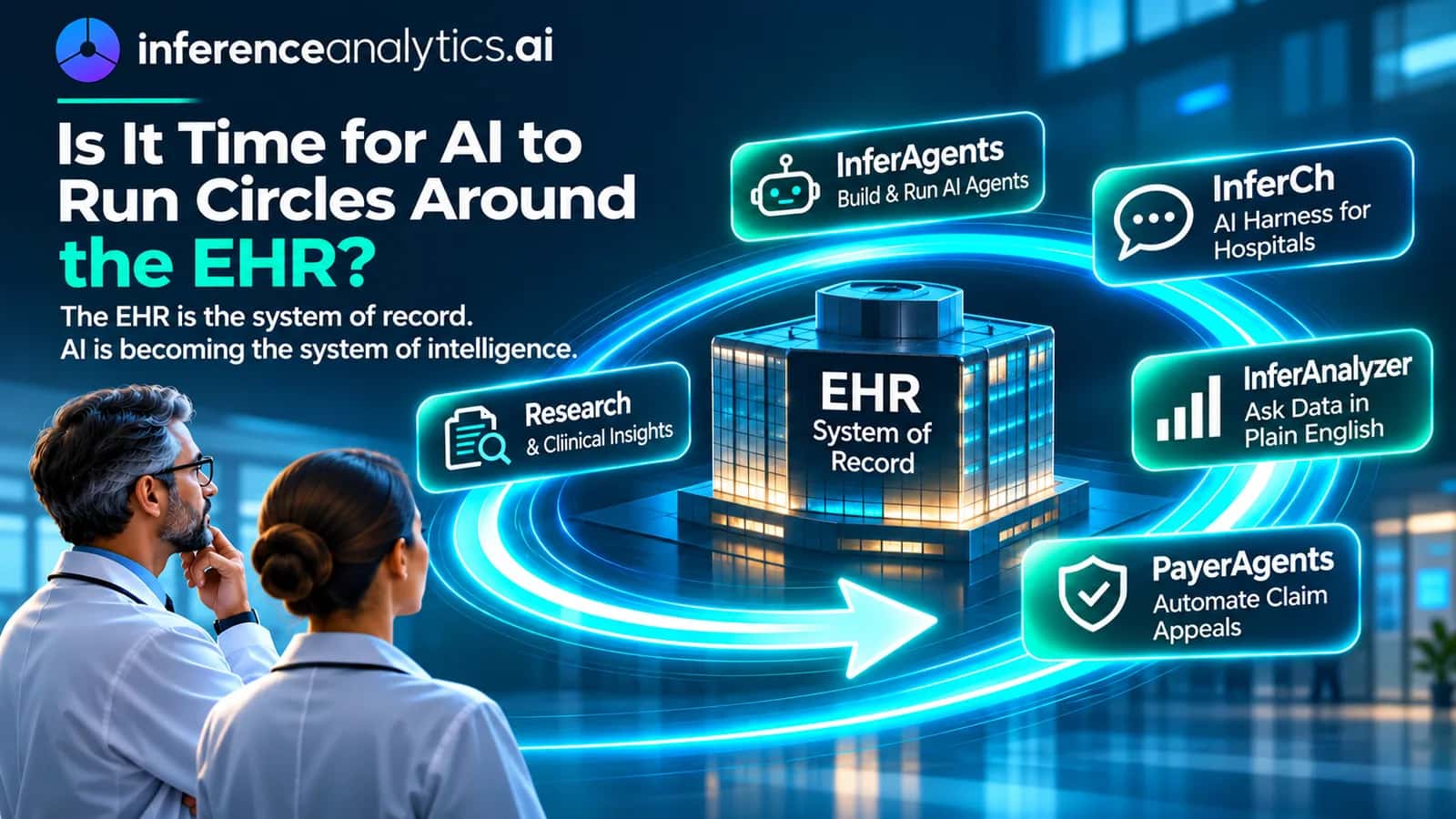
One of the most promising developments is the emergence of agentic AI in healthcare.
Unlike traditional chatbots that primarily respond to questions, AI agents can help execute multistep workflows, retrieve relevant information, coordinate actions, and support operational decisions.
Consider some of the opportunities:
- Revenue cycle operations, including claims management and denial appeals
- Clinical and administrative knowledge retrieval
- Patient and provider concierge services
- Healthcare analytics and operational intelligence
- Workflow automation across disconnected enterprise systems
The opportunity is significant, particularly in an industry where highly trained professionals spend considerable time navigating information and administrative processes.
However, successful deployment requires more than intelligent agents. It requires strong governance, integration with institutional knowledge, human oversight, and continuous evaluation.
3. The Next Competitive Advantage Is Enterprise AI Infrastructure
Healthcare organizations should not have to rebuild their AI infrastructure every time a new foundation model becomes available.
The AI landscape is evolving rapidly, with competing models offering different capabilities, performance characteristics, and costs.
For health systems, this creates a strong argument for model-independent enterprise AI platforms.
Such platforms can help organizations select appropriate models for different workflows while maintaining consistent security, governance, access controls, and operational oversight.
They can also provide a foundation for scaling AI beyond isolated departmental experiments.
The long-term value is not in choosing one winning AI model. It is in building an enterprise architecture capable of benefiting from continued AI innovation.
4. What We Have Learned Deploying AI in Healthcare
At Inference Analytics, we have had the opportunity to move beyond theoretical discussions and implement AI technology in real healthcare environments.
Our solutions are deployed at health systems including University of Chicago Medicine and Mayo Clinic, with more than 3,000 users leveraging our technology across healthcare workflows.
These experiences have reinforced several important lessons.
First, successful AI implementation requires close collaboration with the people who understand the workflows. Technology teams, clinicians, operational leaders, and frontline users all play essential roles.
Second, institutional knowledge matters. Healthcare organizations operate with complex policies, procedures, and local practices that generic AI models cannot automatically understand.
Third, continuous improvement is essential. An AI application must remain aligned with changing organizational needs long after its initial deployment.
And finally, security and governance must be designed into the platform rather than added after implementation.
These principles have shaped how we approach enterprise AI at Inference Analytics.
5. Where Healthcare AI Goes Next
As I meet with healthcare leaders, innovators, and technology companies at HLTH, I see an industry moving toward a more mature understanding of AI.
The excitement around foundational models remains justified. But the real opportunity lies in translating that innovation into measurable improvements in healthcare delivery and operations.
Over the next several years, I believe the most successful healthcare AI initiatives will share three characteristics: deep understanding of healthcare workflows, enterprise-grade infrastructure that can adapt as AI evolves, and close partnerships between technology providers and healthcare professionals.
Healthcare AI’s future will not be determined by technology alone.
It will be determined by how effectively we bring together advanced AI, institutional knowledge, and the people who deliver healthcare every day.
That is the opportunity we are focused on at Inference Analytics.