For decades, healthcare technology has revolved around the Electronic Health Record (EHR).
Originally developed to manage clinical information, EHRs evolved into systems heavily shaped by billing, reimbursement, documentation, and regulatory requirements.
They became essential to healthcare. But they also became gatekeepers of innovation.
Want to build something new? First, figure out how to integrate with the EHR.
Restrictive APIs, costly integrations, complex approvals, and lengthy development cycles have often made innovation harder than it needs to be.
But AI is beginning to change that equation.
We're Seeing Something Remarkable
At Inference Analytics, our AI platforms support several thousand users across major academic medical systems.
Our platform includes:
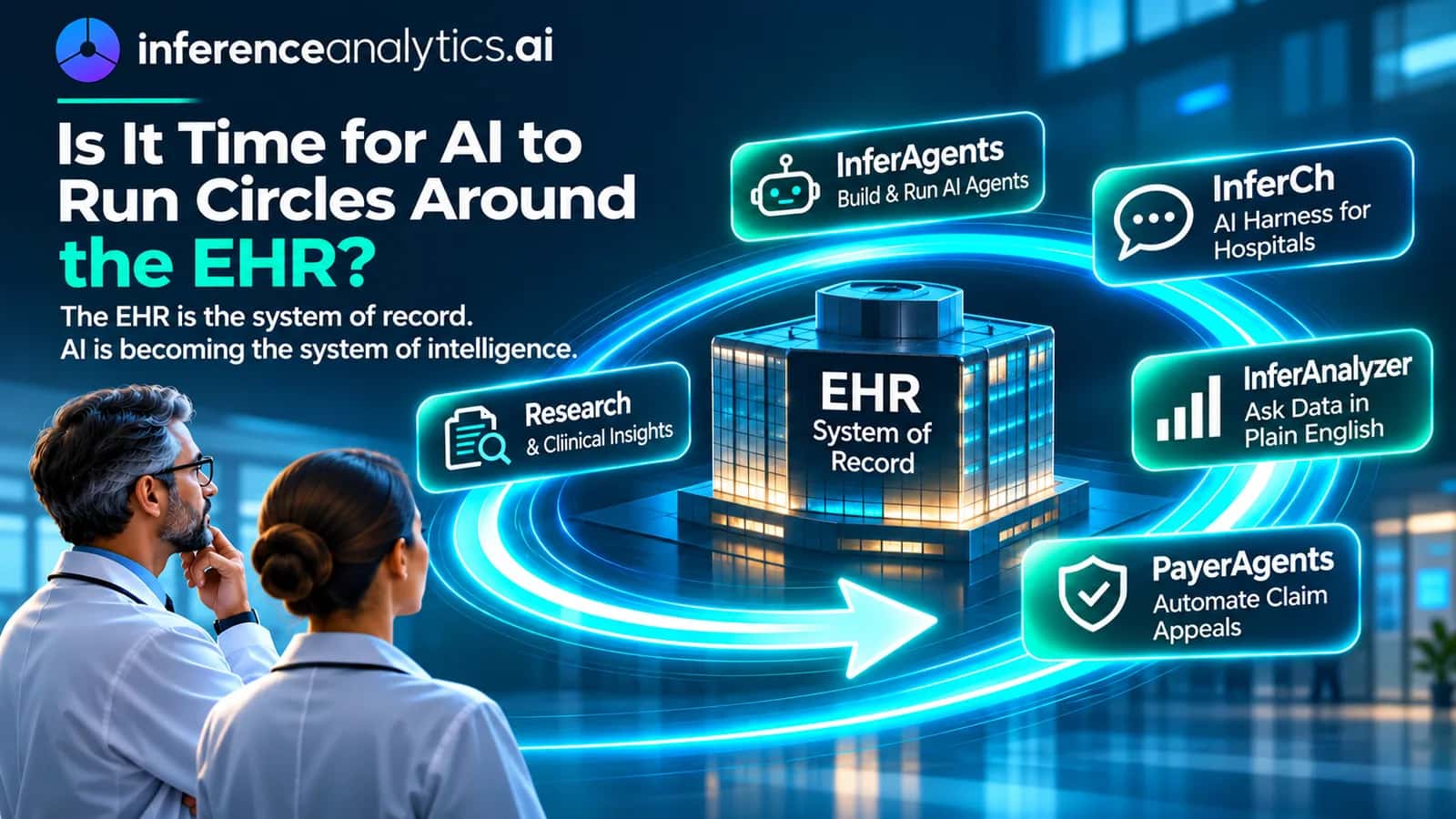
- InferAgents: A platform for building and deploying HIPAA-compliant AI agents and workflows.
- InferCh: A HIPAA-compliant enterprise AI harness providing secure access to multiple AI models and agents, with governance and cost optimization.
- InferAnalyzer: An AI-powered analytics assistant that lets users query structured data in natural language.
- PayerAgents: AI agents that automate the preparation of healthcare claim denial appeals.
Here's what's particularly interesting.
Across these deployments, we have not needed direct EHR integration to deliver meaningful value.
Hospital teams are using AI to accelerate research, analyze information, automate administrative processes, and tackle complex workflows.
And increasingly, users aren't asking how to bring AI into the EHR. They're asking what else AI can do.
When the Value Is Compelling, Users Find a Way
Consider our PayerAgents solution. AI agents automate much of the work involved in preparing insurance claim denial appeals, dramatically improving productivity.
Today, users can take those AI-generated appeals and manually enter them into their existing EHR or revenue cycle workflows.
Is that the ideal long-term solution? No. But it demonstrates something important.
The value is compelling enough that users are willing to bridge the integration gap themselves.
Innovation no longer needs to wait for EHR integration to prove its worth.
From System of Record to System of Intelligence
The EHR isn't going away. Nor should it. Patient records, clinical orders, documentation, and billing still require authoritative systems with appropriate controls.
But why should every new capability have to live inside the EHR?
Enterprise AI harnesses, intelligent agents, and natural-language analytics are creating a new layer of intelligence across healthcare.
AI can help people work across documents, databases, and applications, connecting with the EHR when necessary rather than making it the starting point for every workflow.
Maybe We're Asking the Wrong Question
For years, we've asked: How do we integrate AI into the EHR?
Perhaps the better question is: How does the EHR fit into an AI-powered healthcare enterprise?
AI is opening doors to productivity and innovation that were previously too difficult, expensive, or simply out of reach.
The EHR will remain healthcare's system of record. But AI is becoming its system of intelligence.
And that could fundamentally change where healthcare innovation happens.
Inference Analytics builds enterprise AI platforms and intelligent agents for healthcare and other regulated industries.