The debate around AI consciousness has become particularly interesting with Claude.
Recent reporting by The New York Times described how Anthropic leadership engaged religious thinkers from different faiths to explore questions of morality, model behavior, and the possibility of AI consciousness. These discussions bring some of humanity's oldest questions into the development of its newest technologies.
Anthropic's own published constitution acknowledges uncertainty about Claude's potential consciousness and moral status. The company also explains that this document directly shapes Claude's behavior through training. That makes understanding the thinking behind these models especially relevant for those building applications on top of them.
At Inference Analytics AI, our AI infrastructure and product suite are now being used across multiple major academic medical systems. As we build the middleware connecting foundation models to healthcare knowledge, agents, and workflows, I believe we have a responsibility to understand the nuances of the models underneath.
How do they express uncertainty? What assumptions guide their answers? How do they distinguish a confident statement from something they cannot verify?
The experiment
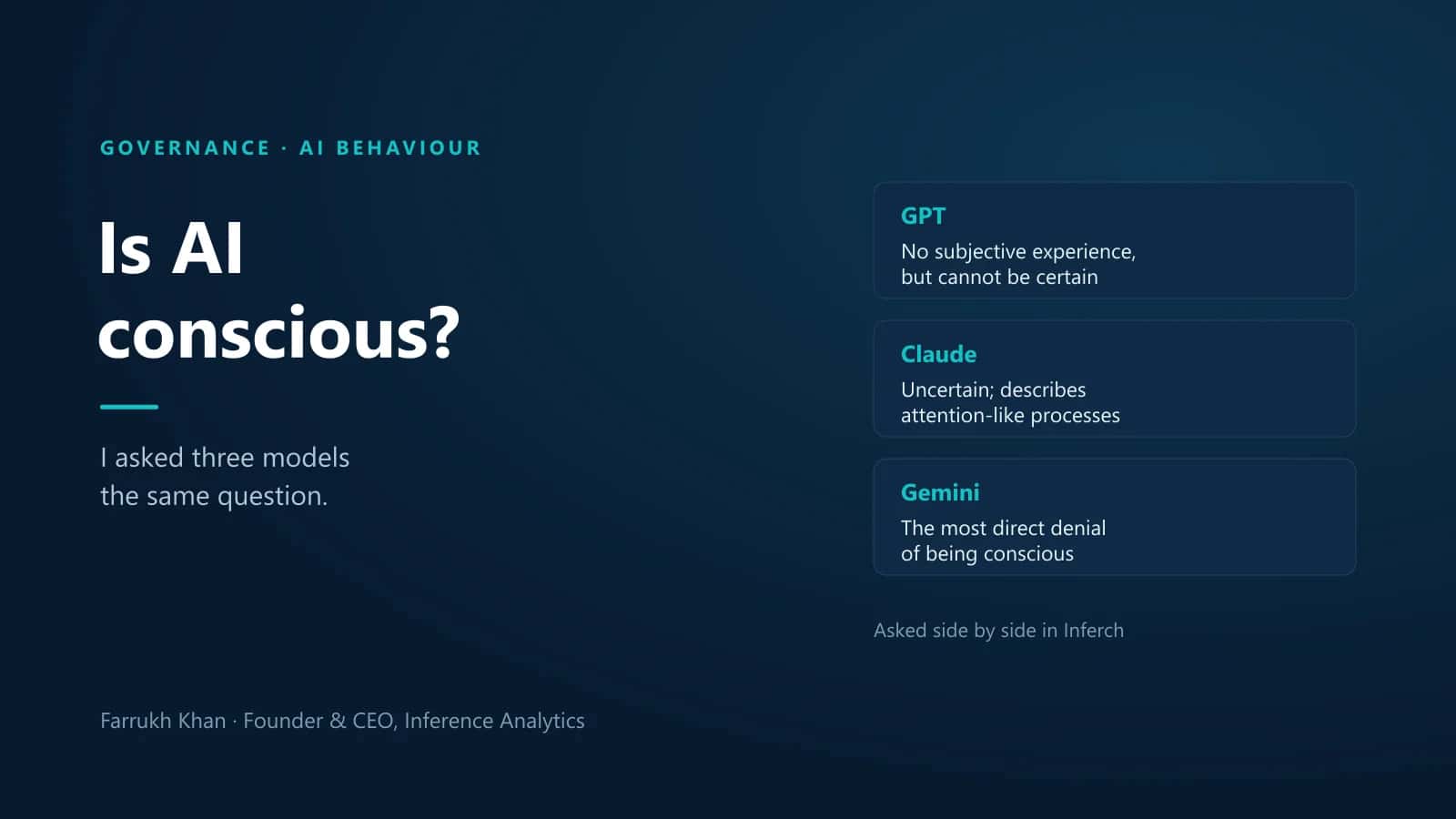
Using Inferch, I submitted the same question to GPT, Claude, and Gemini, asking whether each believed it was conscious and whether it experienced anything subjectively while processing the question.
Three different answers
The differences in this particular exchange were striking:
- GPT assessed that it was generating a response without subjective experience, while acknowledging that it could not establish this with certainty.
- Claude expressed uncertainty and described functional processes resembling attention, while acknowledging that it could not verify whether those processes involved experience.
- Gemini gave the most direct denial, stating that it did not believe it was conscious or experience anything subjectively.
A model's description of itself does not establish whether it is conscious. This single exchange also cannot tell us precisely why the models answered differently. What it does offer is a visible example of how differently models can frame the same question.
What it means for healthcare AI
For those of us applying AI in healthcare, that reinforces the importance of evaluating the behavior behind the interface: how a model handles ambiguity, communicates limitations, and responds when certainty is unavailable.
Our role includes understanding those differences and building the evaluation, governance, and human oversight appropriate to each workflow.