Request Demo

Healthcare AI infrastructure

AI Built for the
Future of Healthcare.

One Enterprise AI Platform. From Intelligence to Action.

Secure AI infrastructure for healthcare: build intelligent agents, govern leading AI models and connect enterprise data, moving from AI experimentation to measurable operational impact.

Recognized byNVIDIA Agentic Health showcaseTechNexus Chicago HealthTech map
Clinical data flowing through layered AI infrastructure and coming out as secure, trusted decisions
Built for the healthcare enterprise
  • Healthcare-native
  • Model-independent
  • HIPAA-ready architecture
  • Production-grade governance
Active users
3,000+
Queries processed
200,000+
Agents live
80+
Years of R&D1
8+

1Platform-wide across all deployments, as of September 2026. Years of R&D covers the founding team’s combined AI research and deployment work, before the June 2025 production launch.

The Inference Analytics Platform

One agentic AI platform.
Built for healthcare.

Build agents with InferAgents, govern every model with Inferch, and analyze enterprise data with InferAnalyzer. Healthcare applications such as PayerAgents run on the same HIPAA-compliant core.

Cut token costs and build agents 10× faster

01
Build Intelligent AI Agents

InferAgents

InferAgents.ai

Design, test, orchestrate and deploy enterprise AI agents using visual workflows, flexible model access and enterprise controls.

  • Reduce token costs on every agent
  • Any model, no lock-in
  • Build and orchestrate multi-step agents visually
Learn More

Up to 80% lower Gen AI costs, with no model lock-in

02
The Enterprise AI Harness

Inferch

InferCh.ai

Access and govern leading AI models through one secure workspace. Switch models, compare and fuse responses, and optimize inference costs.

  • Approved access to leading models, no lock-in
  • Multi-model response fusion
  • Intelligent cost optimization
Learn More

Ask your data anything, in plain language, with no SQL

03
Enterprise Data Intelligence

InferAnalyzer

Connect structured data from supported SQL databases, Tableau environments, Excel files and CSVs. Ask questions in natural language and turn business data into actionable insights.

  • Supported SQL, Tableau, Excel and CSV sources
  • Answers as summaries, comparisons and charts
  • Controlled access and transparent calculations
Learn More

Healthcare AI applicationsBuilt on the platform

Intelligent Revenue Cycle Automation

PayerAgents PayerAgents.ai

Streamline payer policy research and denial appeal preparation with specialized healthcare AI agents.

Explore PayerAgents
20×
more payer appeals
50%+
faster appeal turnover

AI agent dev studio

Build intelligent AI agents. Any model. Any workflow.

Visually build, orchestrate and deploy enterprise AI agents that connect data, applications and AI models. InferAgents brings together flexible development, enterprise governance and intelligent optimization to help lower AI operating costs.

  • Visual agent builder for reasoning, knowledge, tools and multi-step workflows
  • Commercial, open-source or private models, chosen on quality, latency and cost
  • Context, model choice and consumption managed to lower token costs
See InferAgents.ai in action
InferAgents.ai / Product tour
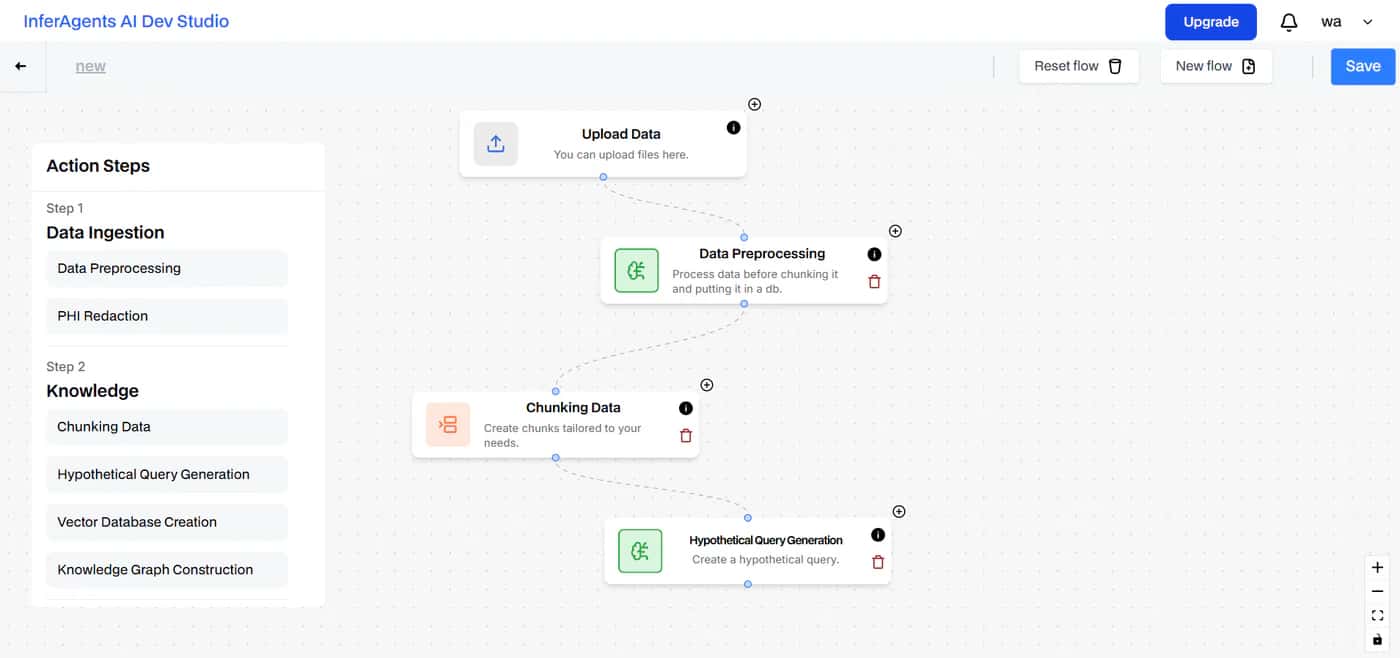
✳ Healthcare RAG Flow012Upload DataPHI Redactionhipaa-guard512 tokensChunking Datagpt-4.1Hypothetical QueryGenerationtext-embedding-3Vector DatabaseCreationAgent live/rag/ia-chat-assist
01

Build It Visually

Place the steps, wire them up, pick a model, ship the endpoint.

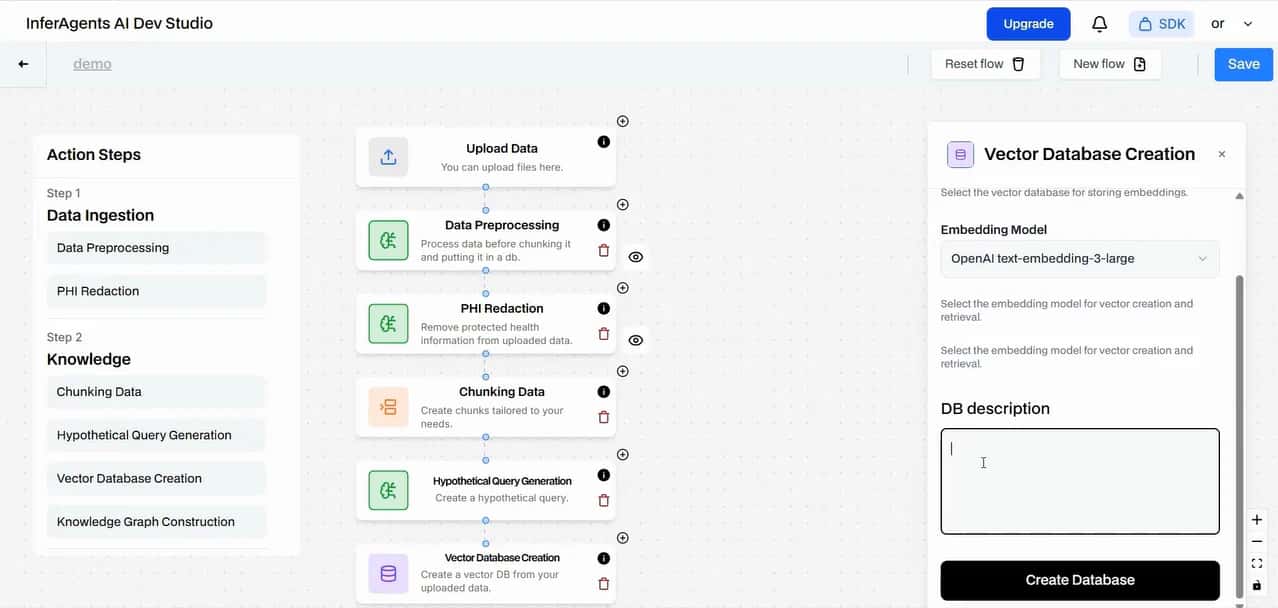
The InferAgents flow canvas: Upload Data, Data Preprocessing, Chunking Data and Hypothetical Query Generation wired together, beside an Action Steps rail grouped into Data Ingestion and Knowledge.02

Agent Studio

Drag the flow together: ingestion, redaction, chunking, retrieval.

Vector Database Creation open in InferAgents, choosing an embedding model for the vector store beside the flow it belongs to.03

Knowledge Hub

Choose the embedding model and build the vector store behind it.

Scroll to explore

The enterprise AI harness

All your AI models. One workspace. Up to 80% lower Gen AI costs.

Inferch unifies leading AI models in one secure enterprise application. Switch models instantly, compare and fuse their responses for richer insights, and optimize model and token usage to lower your Gen AI costs by as much as 80% on qualifying workloads.

  • One application. Every AI model.
  • Multiple models. One smarter answer.
  • Lower Gen AI costs by up to 80% on qualifying workloads.
See InferCh.ai in action
InferCh.ai / Product tour
inferch.ai/chatINFERCHUser>_CANDIDATE RESPONSESHide>_CLAUDE SONNET 4-6• CAD, s/p LAD stent (2019)• HFrEF, EF 38%, echo 03/24• Paroxysmal AF since 2022• Apixaban, metoprolol, statin• No bleeding events to dateUse this>_GPT 5.268 y/o male with coronaryartery disease, s/p PCI to theLAD in 2019 after NSTEMI.Course complicated by reducedEF (38%) and controlled AF.Use this>_GEMINI 3.1 PRO2019: NSTEMI, LAD stent2022: new-onset AF2024: EF 38% on echoRx: apixaban, metoprolol,atorvastatin 80 mg, lisinoprilUse this✳ FUSION RESPONSE3 models · supervised by GPT68 y/o male with coronary artery disease, s/p LAD stent in 2019following NSTEMI. Course complicated by paroxysmal AF (2022) andHFrEF with ejection fraction 38% on echocardiogram, March 2024.Current: apixaban, metoprolol, atorvastatin 80 mg, lisinopril.No bleeding events on anticoagulation; last lipid panel at goal.3 of 3 models agreed on diagnoses · 1 discrepancy resolved: echo dateGENERATE FUSION RESPONSECOMPARE RESPONSEFusionGPT5.2GPT5.4SONNETGEMINIG-FLASHFUSION (0)Supervisor: GPTSelect models to startFUSION (0)Supervisor: GPTMessage Fusion (3 models)…
01

Fuse The Answers

Ask three models at once, then reconcile them into one answer.

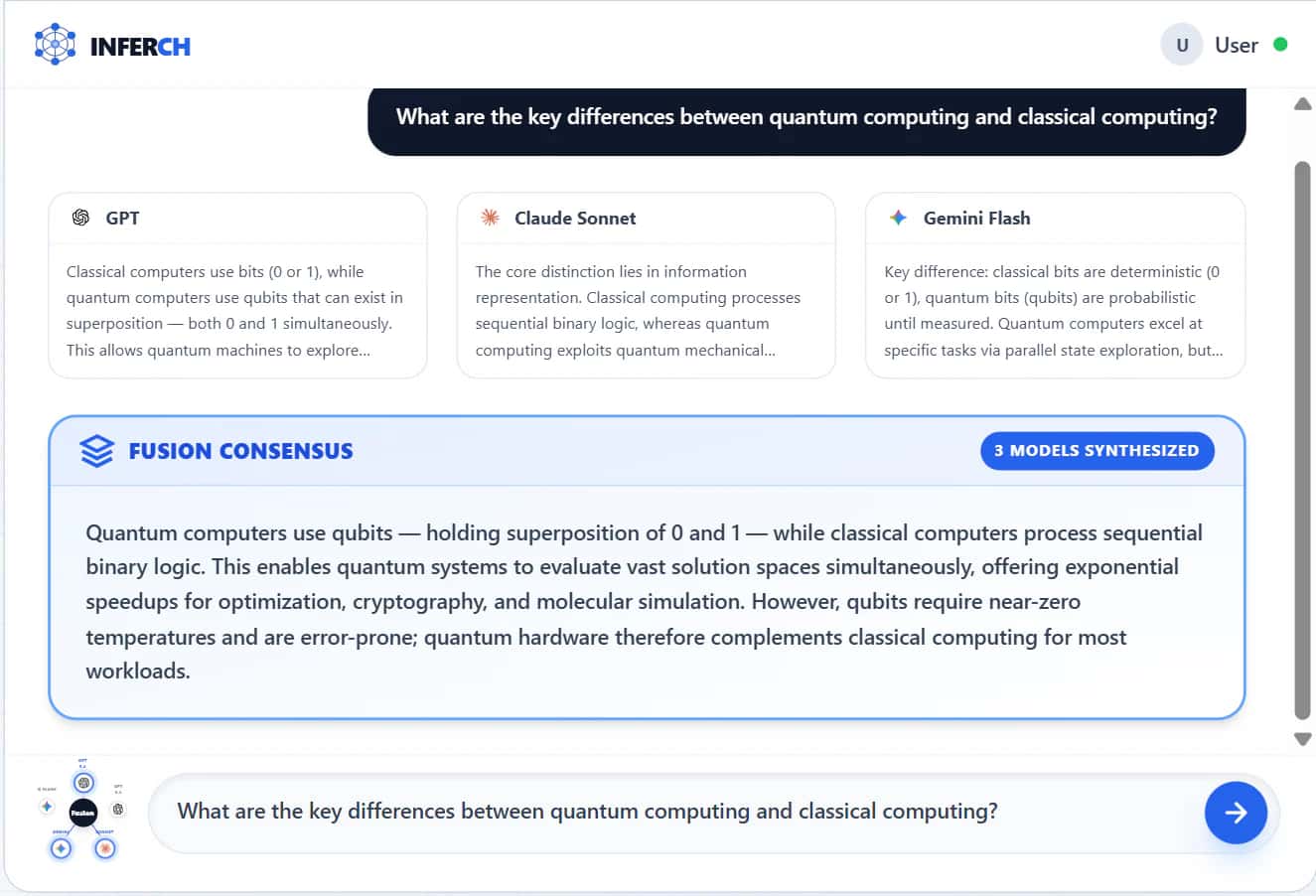
Inferch showing candidate responses from Claude Sonnet, GPT-5 and Gemini Pro side by side, with Generate Fusion Response and Compare Response beneath them.02

Multi-Model Chat

Ask several models the same question, then fuse the answers into one.

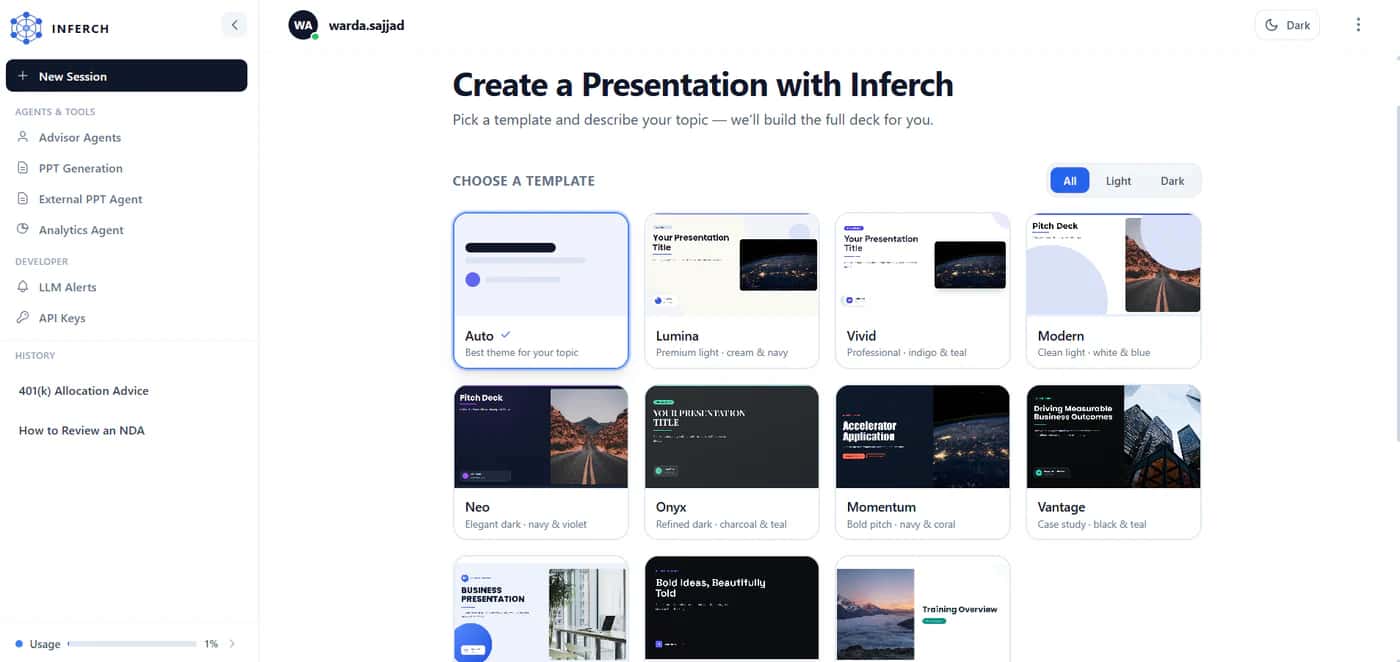
The Inferch presentation builder: a template picker with light and dark deck themes, beside a sidebar listing Advisor Agents, PPT Generation, External PPT Agent and Analytics Agent.03

Presentation Agent

Describe the topic, pick a template, get the finished deck.

Scroll to explore

Enterprise AI analytics agent

Your data. Your questions. Instant intelligence.

Your organization already has the data. InferAnalyzer connects supported SQL databases, Tableau environments, Excel spreadsheets and CSV files to an intelligent analytics agent, so teams can ask questions in natural language, explore trends and generate charts without writing SQL or building new dashboards.

  • Ask business questions in natural language
  • Authorized queries and calculations on approved datasets
  • Summaries, comparisons and charts, with follow-up questions
See InferAnalyzer in action
InferAnalyzer / Product tour
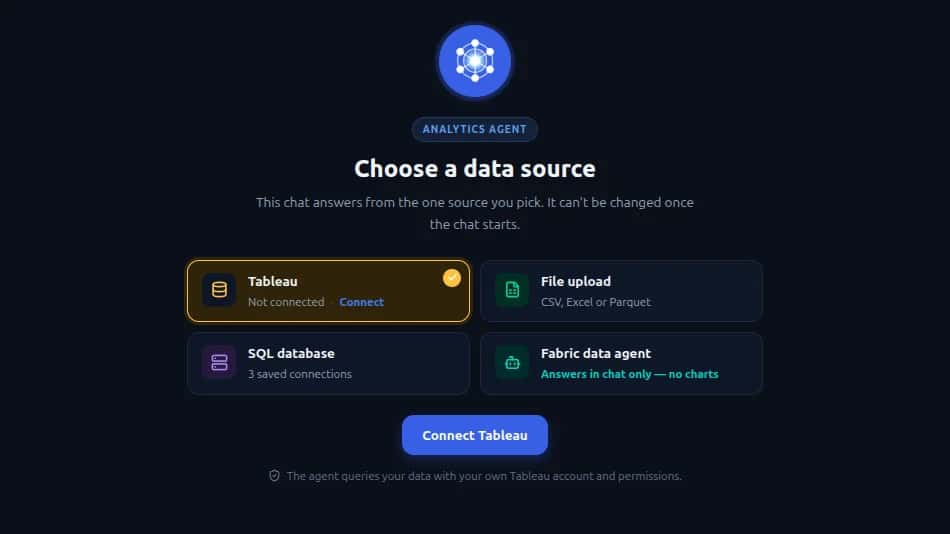
The InferAnalyzer data source picker in light mode, noting that the agent queries data with the user’s own Tableau account and permissions.01

Your Own Permissions

The agent queries data with your own account and access rights.

InferAnalyzerINFERANALYZERUserDATA SOURCESSQL ServerTableauExcelCSVApproved datasets onlyWhy did our denial rate increase last quarter?Running authorized query…Denial rate by monthSAMPLE DATA0%5%10%Apr7.1May7.4Jun7.2Jul8.6Aug9.3Sep9.8Denials rose from 7.2% to 9.2% in Q3, mostly prior-authorization denials at two payers after a policy change.Ask a follow-up question…
02

Ask Your Data

A business question in, an authorized query, a chart and a summary out.

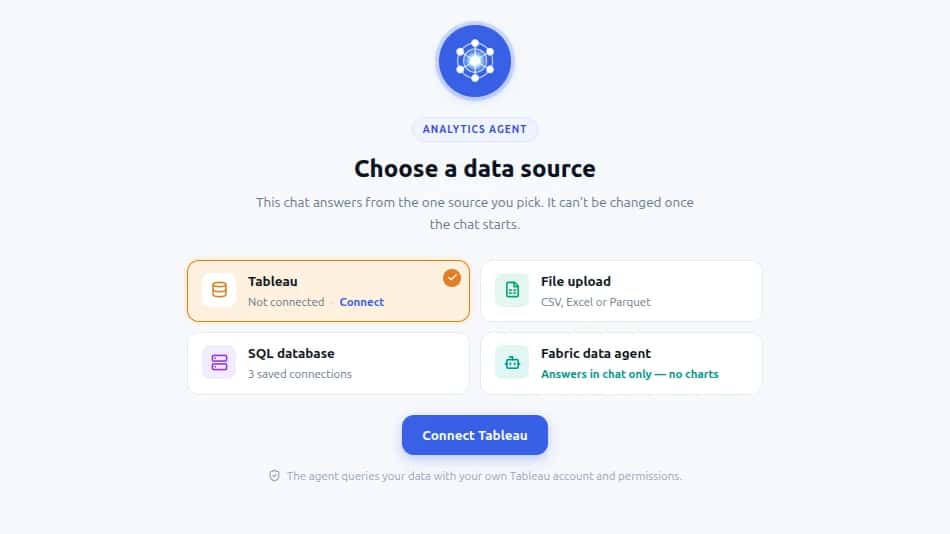
InferAnalyzer asking the user to choose a data source: Tableau, a file upload (CSV, Excel or Parquet), a SQL database with three saved connections, or a Fabric data agent, with Connect Tableau selected.03

Choose A Data Source

Pick Tableau, a SQL database, a file upload or a Fabric data agent.

Scroll to explore

Healthcare AI application · Revenue cycle

Transform payer denials into precise, actionable appeals.

Purpose-built payer agents understand policy language, CPT requirements, and appeal context, helping revenue-cycle teams move faster while keeping every decision reviewable.

  • Payer-specific denial appeal generation
  • Automated CPT and policy lookup
  • Workflow visibility from denial to resolution
See PayerAgents.ai in action
PayerAgents.ai / Product tour
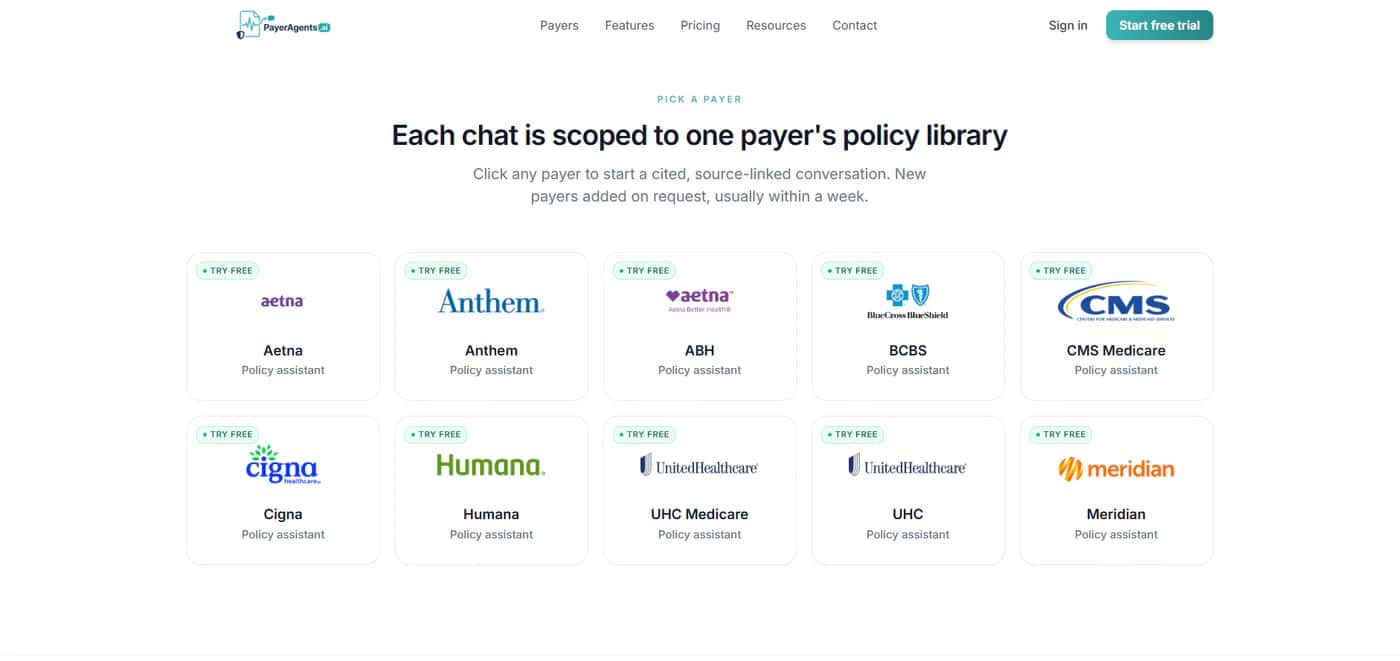
The PayerAgents payer library: policy assistants for Aetna, Anthem, ABH, BCBS, CMS Medicare, Cigna, Humana, UHC Medicare, UHC and Meridian, each scoped to that payer.01

Payer Library

Every chat scoped to one payer's own policy library.

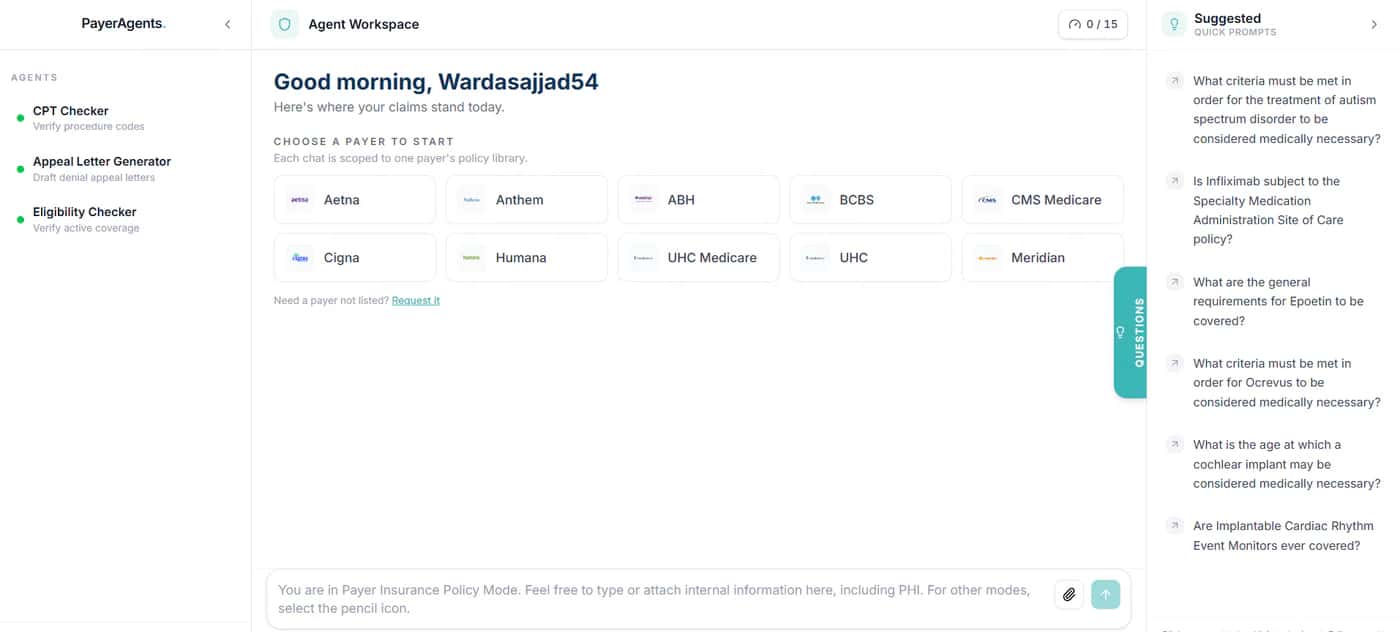
The PayerAgents agent workspace, with a CPT Checker, Appeal Letter Generator and Eligibility Checker in the rail, a payer picker in the centre and suggested policy questions alongside.02

Agent Workspace

CPT checks, appeal letters and eligibility, in one place.

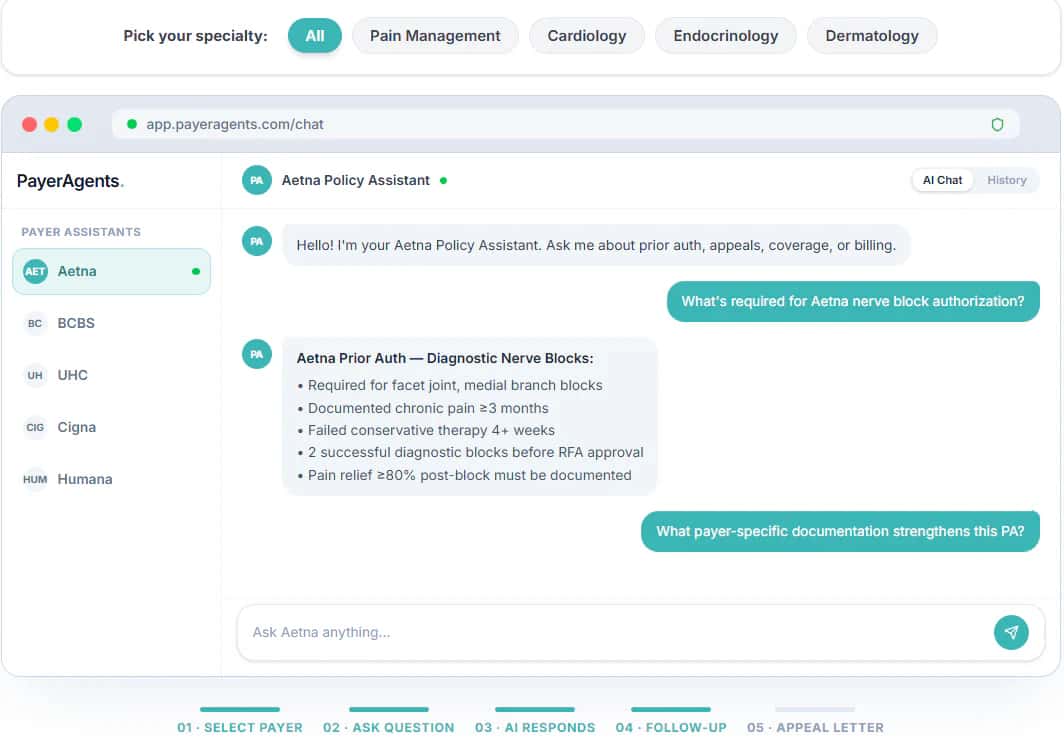
A PayerAgents policy assistant answering an Aetna authorization question with that payer's own documented requirements listed in full.03

Policy Intelligence

Answers carrying the payer's own requirements, cited to source.

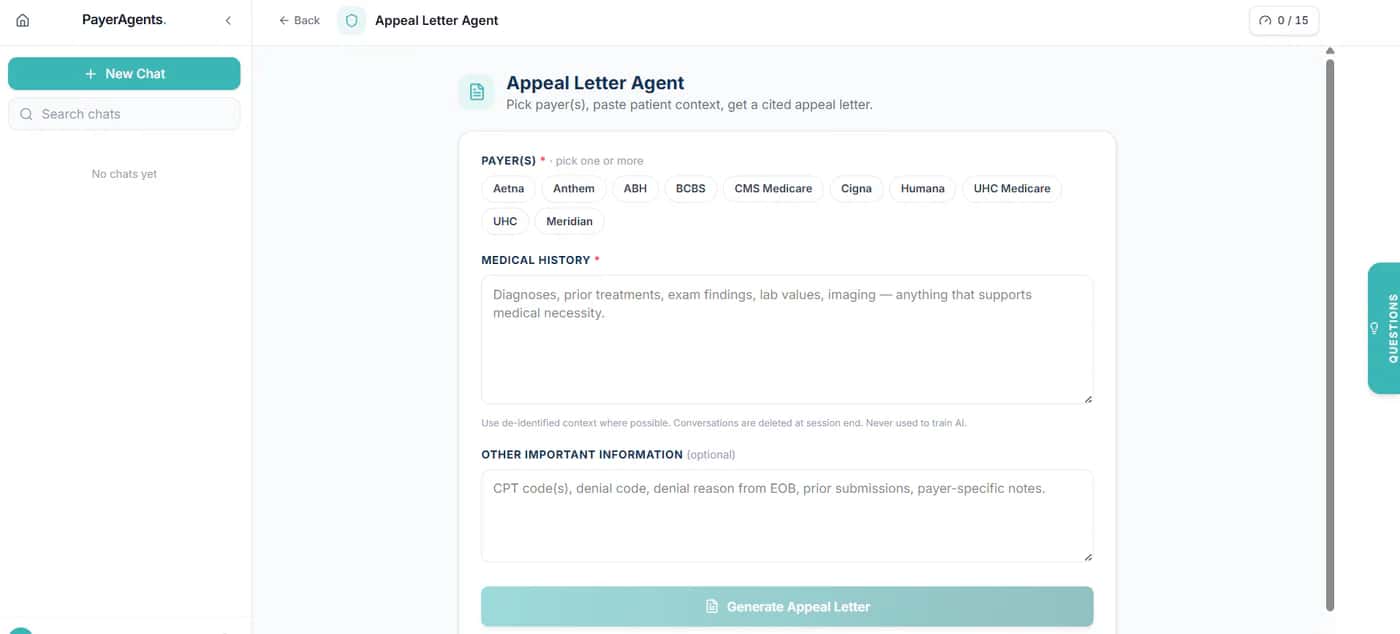
The PayerAgents Appeal Letter Agent: pick one or more payers, paste the medical history and denial details, and generate a cited appeal letter.04

Appeal Builder

Pick the payers, paste the context, get a cited appeal letter.

Scroll to explore

About us

Healthcare-native
from day one.

We work inside the constraints healthcare actually has: protected data, audited workflows and clinical accountability. The platform is engineered so enterprise teams can adopt AI without trading away security or governance. It runs on major cloud providers inside a HIPAA-compliant boundary, and models are reached only at the API level under a business associate agreement.

Fig. 01Retrieve · Reason · Act · Review

HIPAA BOUNDARYPHI never leaves this lineRetrieveYour recordsReasonAny modelActIn your systemsReviewA human signs offOpenAIAnthropicGoogleYour ownAPI ONLYUnder a BAA
  1. 8+

    Years of R&D before we productized anything

  2. 2021

    Peer-reviewed in IEEE Transactions on AI

    Read the paper ↗
  3. 4x

    User growth since the June 2025 launch

Live at

  • University of Chicago Medicine
  • Mayo Clinic

Following the same path

  • Akron Children's
  • CHOP
Common questions

The company and its products, explained

What is Inference Analytics?

Inference Analytics is a Chicago-based healthcare AI company. Its Inference Analytics Platform has three core products: InferAgents (InferAgents.ai) for building AI agents, Inferch (Inferch.ai), the enterprise AI harness, and InferAnalyzer for conversational analytics, plus PayerAgents (PayerAgents.ai), its healthcare application for denials and appeals. Its products are live inside University of Chicago Medicine and Mayo Clinic.

What products does Inference Analytics make?

Three core products and an industry application. InferAgents (InferAgents.ai) is a dev studio where teams build, orchestrate and deploy AI agents across any model. Inferch (Inferch.ai) is the enterprise AI harness, where teams access and govern leading AI models, compare and fuse their responses, and optimize inference costs. InferAnalyzer is conversational analytics for structured enterprise data in SQL databases, Tableau, Excel and CSV. PayerAgents (PayerAgents.ai) is the healthcare application for denial appeals and revenue cycle automation. All run on one HIPAA-compliant foundation, hosted on major cloud providers.

Is InferAgents a dev studio?

Yes. InferAgents is the Inference Analytics dev studio for building AI agents, at InferAgents.ai. Its visual builder is called InferAgents Studio.

Is PayerAgents a separate company or a separate product?

Neither. PayerAgents is an industry application from Inference Analytics, with its own site at payeragents.ai. It serves billing teams and private practices, and is built on the same HIPAA-compliant platform as InferAgents, Inferch and InferAnalyzer.

What is InferAgents?

InferAgents is the Inference Analytics dev studio for AI agents, at InferAgents.ai. It is model-agnostic and token-optimized: teams visually build, orchestrate and deploy agents that connect data, applications and AI models, with governance built in, for healthcare and other regulated enterprises.

Is Inference Analytics HIPAA compliant?

Yes. InferAgents, Inferch, InferAnalyzer and PayerAgents, and every agent built in InferAgents, share one HIPAA-compliant core: PHI stays inside the compliance boundary, models are connected only at the API level under a business associate agreement, and all activity is written to an auditable log. See the security and compliance page for the full position.

Where does the platform run, and how is our data protected?

Inference Analytics products are hosted on major cloud providers, inside a HIPAA-compliant boundary. A business associate agreement is signed before any protected health information is used. Model providers are reached only at the API level under a BAA, and prompts, retrieved context and outputs are written to an audit log.

How long has Inference Analytics been working on healthcare AI?

The team was generating healthcare text before ChatGPT existed. Its peer-reviewed work on generating radiology report impressions went to IEEE Xplore early access in June 2021, around eighteen months before ChatGPT's public launch, and appeared in IEEE Transactions on Artificial Intelligence in August 2023. The founding team's combined AI research and deployment work spans more than eight years.

Which AI models do Inference Analytics products support?

They are model-agnostic. They work across OpenAI, Anthropic and Google models as well as a health system's own internal or self-hosted models, connected only at the API level. An agent is built once, so the underlying model can change without rebuilding it.

Who uses Inference Analytics today?

Inference Analytics products are live inside University of Chicago Medicine, where they serve both end-user applications and the health system's own IT agent development, and inside Mayo Clinic. Akron Children's and CHOP are following the same path.

Deploy with confidence.

Bring trusted AI into healthcare operations. Talk with our team about deployment, governance and the workflows you want to automate first.