There is a lot of focus right now on what it takes technically to bring AI into a health system: models, infrastructure, integrations, security and governance. But there is another part that may be even more important: people.
At Inference Analytics AI, we are learning these lessons firsthand as we deploy AI inside healthcare organizations and work alongside the people who ultimately have to make it successful.
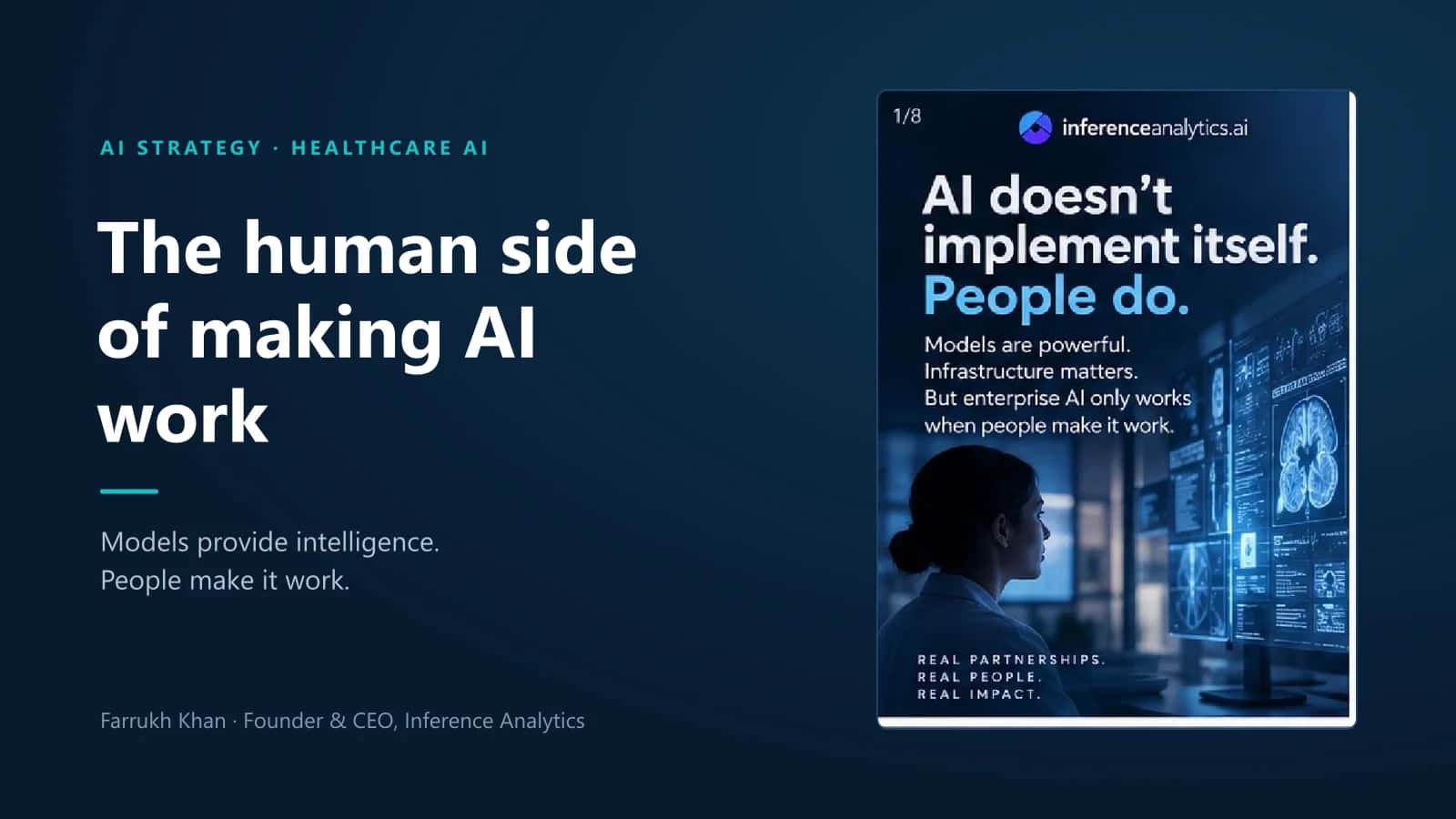
AI doesn't implement itself. People do.
Models are powerful. Infrastructure matters. But enterprise AI only works when people make it work. We spend a lot of time in AI talking about human-in-the-loop. In healthcare, we need to think much bigger than that. Humans aren't just there to supervise the model. Human relationships are what make AI adoption possible in the first place.
A growing divide
On one side is the AI-native world: frontier models, agents, rapid prototyping and constant innovation, moving at extraordinary speed. On the other is enterprise IT, where technology has to work within existing systems, security, compliance, governance, budgets, people and processes. Bridging that divide takes more than great technology. It takes people.
Why healthcare feels it most
Health systems run complex systems, make high-stakes decisions and depend on human-centered workflows across clinicians, IT and security teams, administrators, researchers, revenue cycle teams and patients. Technology alone doesn't drive adoption.
Three human factors
- Deep partnerships drive adoption. You can't drop AI into a health system and expect it to work. Success comes from building trust with IT, clinicians, administrators, security teams and executives.
- AI has to be taught, not just deployed. Agents, RAG, embeddings, context windows, MCP and orchestration need translating into plain English: what it does, where it helps, where it can fail, how it fits the workflow and why it's safe.
- Humility is essential. AI gets things wrong, models change and integrations break. Real progress comes from a feedback loop: listen, acknowledge, fix, improve and build trust.
The human bridge
Strategy, education, change management, governance and ongoing partnership are what connect the technology to real systems and workflows, and turn AI potential into real impact.
One of the biggest lessons we are learning at Inference Analytics AI is that you can have the best model, the best agent and the best technical architecture in the world and still fail at enterprise AI if you don't bring people along with you.
Models provide intelligence. People make it work.