 01
01Agent Studio
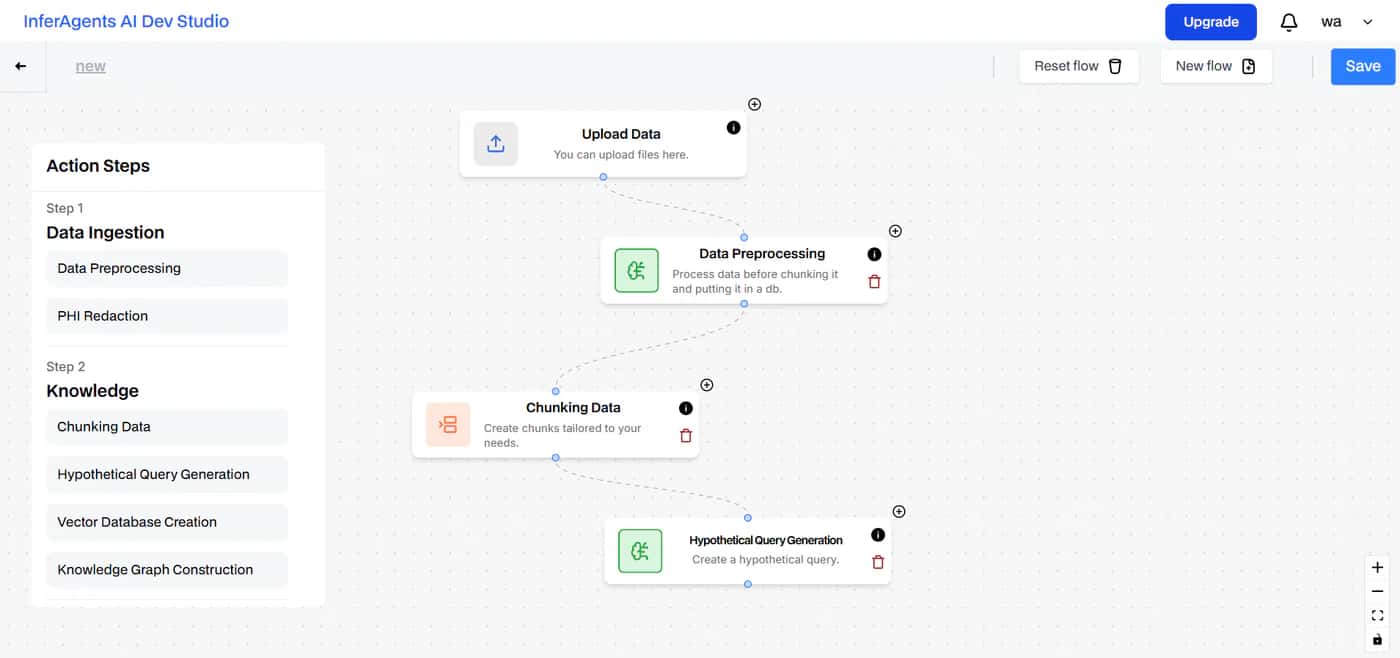
Drag the flow together: ingestion, redaction, chunking, retrieval.
The model-agnostic AI agent development studio that reduces token costs for healthcare and regulated enterprises.
Cut token spend without cutting capability: InferAgents trims context, picks the right model for each step and keeps consumption within budget.
Choose supported commercial, open-source or private models based on quality, latency and cost.
Create agents that combine reasoning, knowledge, tools and multi-step workflows in a visual studio.
Assemble agent logic and workflows visually.
Add knowledge sources, models, applications and APIs.
Tune context, model choice, quality and token economics.
Test, version, release and monitor with enterprise controls.
01Drag the flow together: ingestion, redaction, chunking, retrieval.
 02
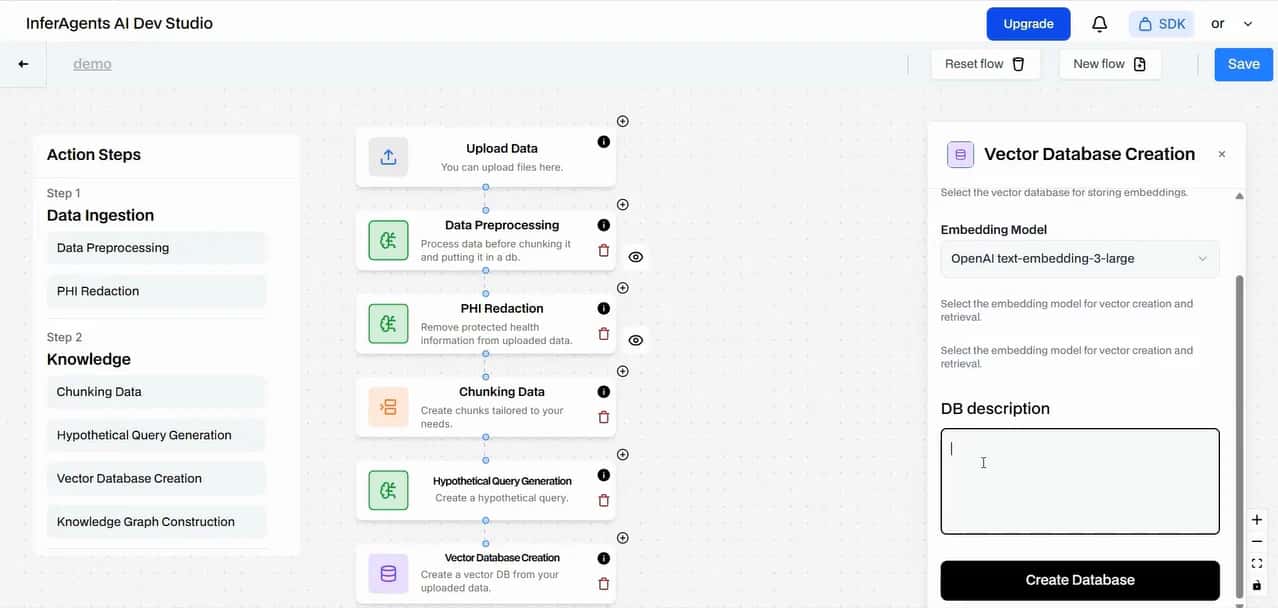
02Choose the embedding model and build the vector store behind it.
Scroll to explore
Context, model choice and budgets, tuned to cut spend.
Design agents and multi-step workflows in InferAgents Studio.
Commercial, open-source or private, chosen per task.
Agents grounded in trusted documents and data.
Agents that act in the systems you already run.
Permissions, audit, versioning and release control.
InferAgents is the Inference Analytics dev studio for AI agents, at InferAgents.ai. It is model-agnostic and token-optimized: teams visually build, orchestrate and deploy agents that connect data, applications and AI models, with enterprise governance built in. Its visual builder is InferAgents Studio.
Reducing token costs is what InferAgents is built for. It sends each model only the context it needs, retrieves only relevant knowledge, picks the right model for each step, so routine steps don't run on the most expensive model, and makes usage visible per user, team and agent with budget controls.
IT, informatics and engineering teams in healthcare and other regulated enterprises. At University of Chicago Medicine, the health system's own IT organisation builds agents in it directly.
Supported commercial, open-source and private models. Teams choose a model per task based on quality, latency and cost, and can change it without rebuilding the agent.
No. InferAgents is set up with each organisation and hosted on major cloud providers, with a business associate agreement signed before any protected health information is used.
Not for the common cases: agents are assembled visually from ready-made stages. Connecting new source systems and approving production releases remain engineering work.
Copilot Studio and Bedrock AgentCore are general-purpose agent tools tied to one cloud. InferAgents is built for healthcare and regulated enterprises and works across model providers. Our sourced comparison of HIPAA-compliant agent platforms sets out where each one fits.
Comparing platforms? Read our sourced comparison of HIPAA-compliant AI agent platforms →