ProductsCompanyBlogRequest Demo
A product in the InferAgents Suite
inferch.ai

Six models. One truth.

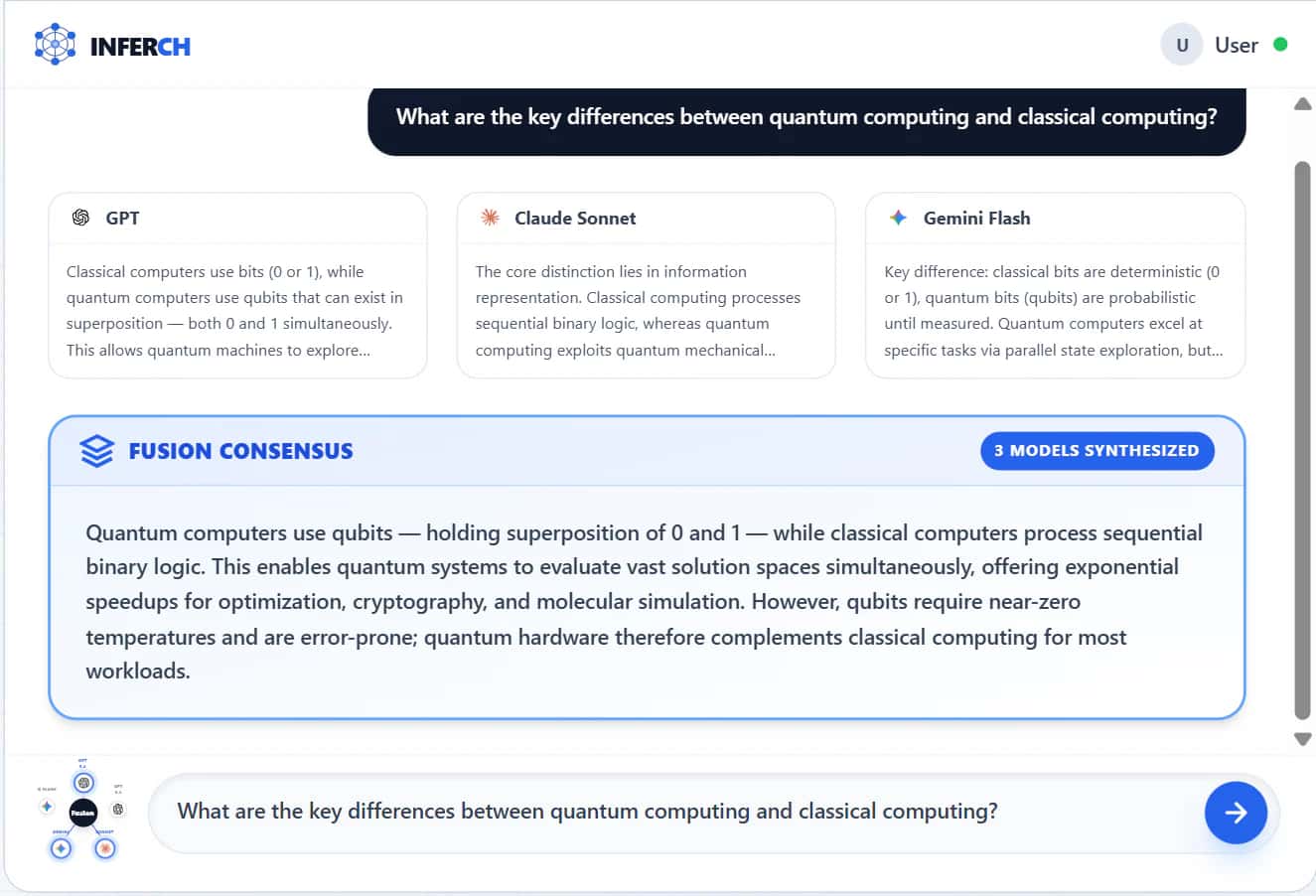
Ask once. Several models answer. A supervisor checks them against each other and returns one.

One prompt · many models · one verified answer
?one promptGPTClaudeGeminiInferLMthey disagreeSupervisorcross-checked · confidence-scored
01Parallel executionYour prompt goes to every model at once — no tab-switching.
Why we built it

One model’s confidence is not the same as being right.

Every model answers fluently. Fluency is not accuracy.

The observation

Staff were already comparing models by hand

People opened three tabs, asked the same question three times, and eyeballed the differences. That instinct is correct — it was just being done manually, without a record.

Why one model isn’t enough

Leadership changes by task and by month

No single model leads at summarisation, extraction and multi-step reasoning simultaneously, and the ranking shifts with each generation. Committing to one is a bet that expires.

The useful signal

Where models disagree is worth seeing

Agreement across independent models is weak evidence of reliability. Disagreement is a flag — and the thing a single confident answer throws away.

Why it belongs in the suite

Compliance is not a per-app problem

Inferch handles the same PHI as everything else. Building it on the suite’s existing compliance core meant not solving that problem a second time.

The line we hold

Inferch does not make clinical decisions and does not write to the patient record. It gives a clinician a better-checked answer and shows its working — the same accountability rule set out in our AI governance position.

What it does

Ask once. Get an answer that has been checked.

Multi-model fusion

Query GPT, Claude and Gemini at once. A supervisor verifies the answer.

Verified consensus

Every answer is cross-checked across models and confidence-scored before it reaches you.

Cost-optimised routing

Routes each query down the cheapest path that still hits target accuracy.

Analytics agent

Raw data into charts, summaries and insights. No spreadsheets.

PPT generation

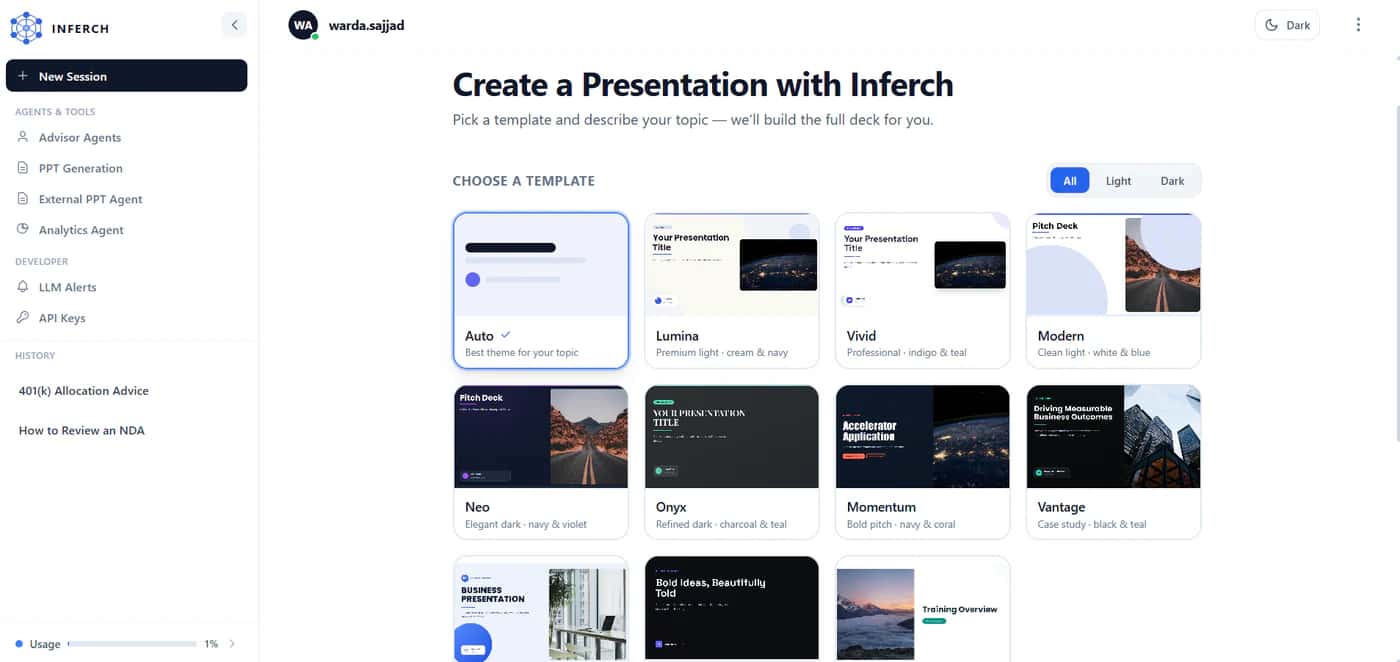
One prompt into a ready-to-present deck.

Advisor agents

Expert personas with domain context and memory across sessions.

What is Inferch?

Inferch is the front end of the InferAgents Suite — the application clinical and operational staff work in. Rather than sending a question to one model, it queries several leading models at once and uses a high-reasoning supervisor to verify the final answer before you see it.

How does the multi-model fusion actually work?

In three steps the product names itself. Parallel execution: your prompt is dispatched to top-tier models simultaneously. Live synthesis: answers stream in and a supervisor model analyses the logic and cross-references facts as they arrive. Verified consensus: the answers are cross-checked across models and confidence-scored before one result is returned.

What is InferLM?

InferLM is the routing and fusion layer. It routes each query through the cheapest path that still reaches the target accuracy, so premium tokens are not spent on work that does not need them. It can act as a candidate model or as the fusion supervisor — one model id, with the whole stack behind it.

What else does Inferch do besides answering questions?

It carries several agents of its own. Advisor agents are expert personas that reason with domain context. The analytics agent turns raw data into charts, summaries and insights without a spreadsheet. The PPT generation agent turns a prompt into a ready-to-present deck. It also supports long-term memory, file uploads, voice-to-text, personalised assistants and automated document generation.

How does Inferch relate to InferAgents?

Inferch is one of the three parts of the InferAgents Suite. It runs on the same HIPAA-compliant core as Dev Studio and PayerAgents, which means it inherits the same PHI boundary, access controls and audit logging rather than implementing its own.

Why query several models instead of one?

Models disagree, and where they disagree is information. Different models lead on different task types, and any single model can produce a confident answer that is wrong. Cross-checking several and scoring the confidence surfaces that disagreement rather than hiding it behind one fluent response.

Can developers build on it?

Yes. Scoped developer API keys with usage tracking let Inferch be dropped into other applications, with fast median latency and deterministic streaming intended for production workloads rather than demonstrations.

See Inferch on its own site.

Product detail and sign-up live at inferch.ai.