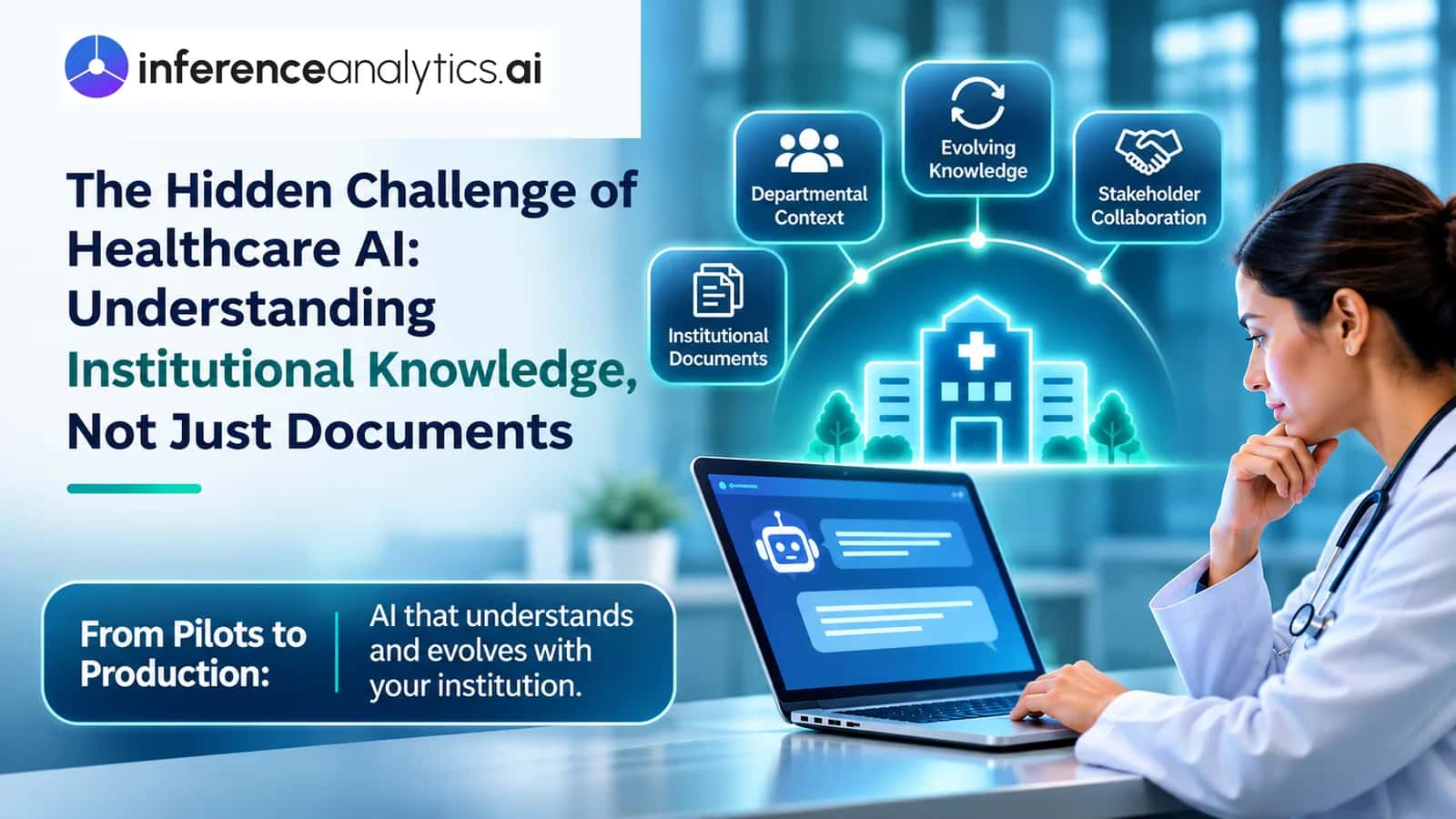
Why Healthcare AI Implementation Is Harder Than a Pilot
Imagine a hospital employee asking an AI assistant a question about an internal policy. The information exists somewhere in SharePoint or another institutional repository. Instead of searching through documents, the employee receives an answer in seconds.
With today’s language models, building a demonstration of this capability is relatively straightforward. But healthcare AI implementation at production scale is a different challenge: an assistant must remain reliable across departments, policies, and changing hospital operations.
At Inference Analytics, our experience working with healthcare institutions has reinforced a fundamental lesson: the hardest part of enterprise healthcare AI is often not the intelligence of the model. It is understanding the institution in which that intelligence must operate.
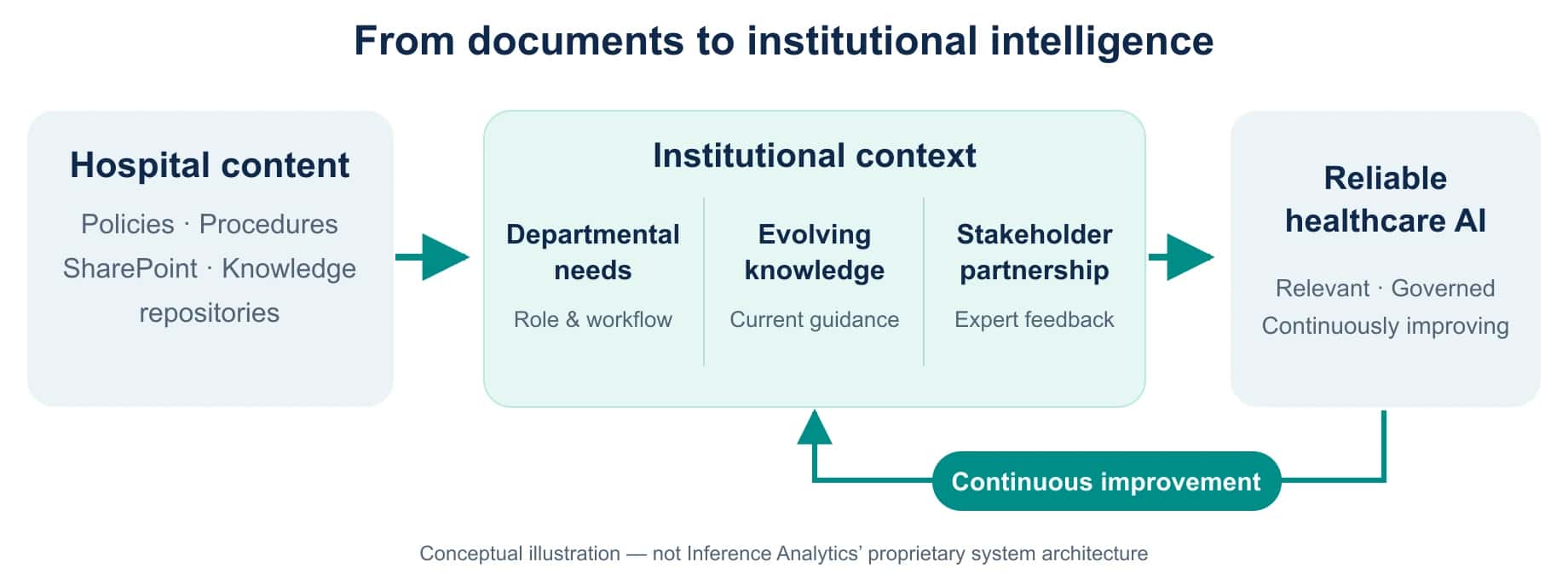
Figure 1. Reliable healthcare AI depends on more than access to documents. Departmental context, changing knowledge, and expert collaboration shape the usefulness of answers.
1. Hospital Knowledge Is More Than Documents
Hospitals maintain extensive institutional knowledge across policies, procedures, departmental resources, and operational guidelines. Connecting AI to these repositories makes information more accessible. But retrieving a document and understanding how it applies to someone’s work are two different things.
Consider a hospital employee asking an AI assistant about an internal employee onboarding policy. A human resources specialist, an IT administrator, and a department manager may ask essentially the same question but need different information. HR may focus on compliance and documentation, IT on system access, and the department manager on operational readiness. An AI response could be factually correct yet incomplete for the person asking.
A response can be factually correct yet incomplete for the department asking. Institutional knowledge includes not only what an organization has documented, but how its people interpret and apply that knowledge.
2. Institutional Knowledge Never Stands Still
Hospital policies change. Procedures are revised. Departments introduce new workflows, and regulatory requirements evolve. An answer that was correct last month may no longer reflect current hospital practices.
A system may generate a convincing answer supported by an authentic document, yet the guidance may already have been superseded. The problem is not necessarily the language model. It is the changing institutional knowledge on which the answer depends.
Production healthcare AI must remain aligned with authoritative information as that information evolves. For AI knowledge management in healthcare, reliability is not something established once during deployment; it must be continuously maintained. Enterprise RAG grounds answers in current, authoritative sources for exactly this reason.
3. Production AI Requires Continuous Human Partnership
Once employees begin using AI in real workflows, they ask questions that were never anticipated during the pilot. They identify missing information, ambiguous policies, and responses that may be technically reasonable but operationally incomplete.
In our experience, successful hospital AI deployment requires ongoing collaboration among technology teams, departmental experts, and the people who maintain institutional knowledge. This human partnership is also an essential part of healthcare AI governance: automated evaluation and monitoring matter, but they cannot replace institutional judgment.
Production AI should be treated as an evolving operational capability, not a finished software installation.
4. Better Models Alone Will Not Solve the Problem
AI models continue to improve rapidly, offering better reasoning, speed, and efficiency. But a more capable model does not automatically understand a hospital’s internal policies, departmental responsibilities, or changing workflows.
Nor does upgrading a model guarantee that an existing AI application will continue producing equally reliable results. The same challenge applies to agentic AI in healthcare: agents that retrieve information or support multi-step workflows still need appropriate institutional context, clear boundaries, and continuous evaluation. Long-term value depends on how effectively enterprise AI in healthcare connects models to operational knowledge.
From AI Pilots to Institutional Intelligence
The question healthcare organizations need to ask is changing. It is no longer simply, “Can AI answer questions about our documents?”
Can AI provide reliable, contextually appropriate answers as our institution, its knowledge, and the underlying technology continue to evolve?
A SharePoint-connected assistant illustrates this distinction. What begins as document search becomes a healthcare AI integration challenge involving institutional understanding, departmental expertise, and ongoing collaboration. These considerations help explain why healthcare AI pilots can struggle to scale.
At Inference Analytics, we believe the next phase of healthcare AI will be defined not simply by more capable models, but by systems that can operate reliably within the complex environments healthcare organizations manage every day.
The future of healthcare AI is not just artificial intelligence. It is artificial intelligence informed by institutional intelligence.
Related reading: The secret to healthcare AI is human partnership and What it really takes to bring AI into a health system.