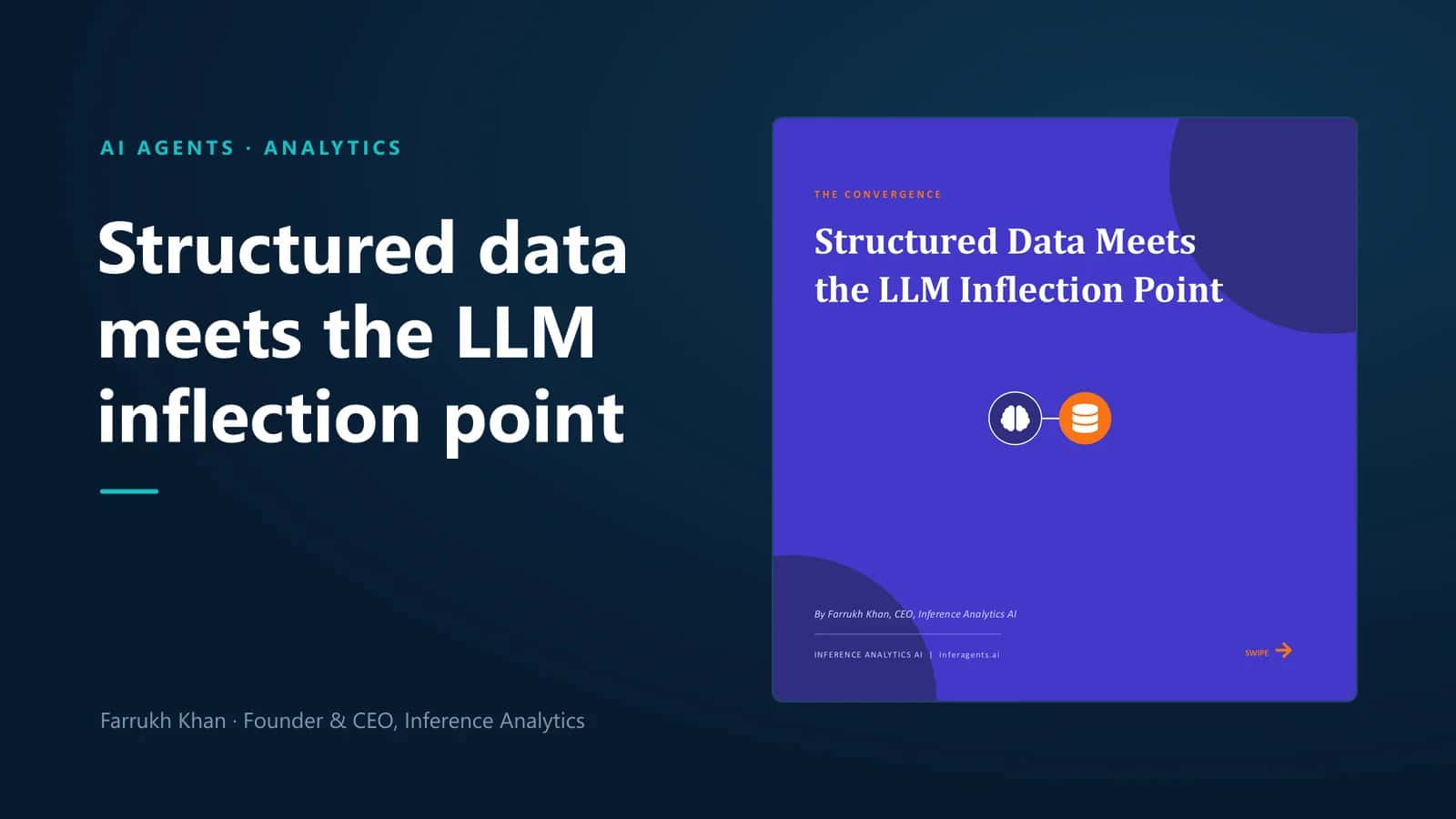
The analytics industry now spends nearly $500B a year, about 8% of all IT spend, cleaning, modeling, and governing structured data. LLMs grew up on the opposite end: language, not schemas. Those two worlds are now colliding.
Decades of schema wars
Star versus snowflake. 3NF versus dimensional. ERDs and data contracts. None of it was ever fully settled.
Then the ground moved
LLMs were built for words. Now they're reaching for your data. MCP opened the gateway: ask, reason, connect and respond, in plain language, with live access to real systems.
The real question
Not “can LLMs help?” but “can LLMs run definitive queries, reliably, against structured data?” In other words: can they be trusted?
Reliable means four things
- Schema awareness: the model understands the tables, keys and definitions it is querying.
- Deterministic execution: the same question returns the same answer.
- Grounded lineage: every number traces back to its source.
- Explainability: the answer shows how it was reached.
Helpful is easy. Trustworthy is the bar.
Where we're building
Much of my career has been in leading product management roles across data and analytics (MicroStrategy, Informatica, IRI, Netezza/IBM), and more recently in AI at Inference Analytics AI, including generative and predictive modeling work well before LLMs entered the picture. I've watched a lot of "this changes everything" claims come and go in analytics, but this one might actually be different. For the last couple of years, we've been experimenting with using LLMs for analytics at Inference Analytics AI, and we're now at a point where this is genuinely achievable.
On InferAgents.ai, that means natural language in and governed, structured answers out: years of data-world discipline, now agentic.
Curious where you land on this. Are you seeing LLMs run real, trustworthy queries against your structured data yet, or are we still early?