API access has become the default way enterprises consume AI, and for good reason. Calling a model through a cloud provider's API is, from a security and privacy standpoint, close to running an open-source model on your own cloud tenant, except for the token cost. That baseline is largely solved.
What isn't solved is everything downstream of the API call. How do you proportion tokens across teams, tasks, and use cases without losing visibility into spend? How do you add new agents without re-architecting the whole system? How do you stay independent of any single model, so you're never locked into one provider's pricing or roadmap? How do you keep the entire setup secure as it scales? And in healthcare specifically, how do you keep all of that HIPAA compliant, with SOC 2 on the roadmap?
The reverse information paradox
You pay for intelligence twice: once in dollars, and again in the knowledge you reveal just to make it useful. In healthcare, that exhaust isn't company knowledge. It's PHI. Patient data and clinical judgment carry a much bigger premium.
Why self-hosting isn't the fix
The obvious answer is to run your own models. But self-hosting means becoming a GPU and MLOps operator, which is not what a health system's AI team is there to do.
The boundary belongs in orchestration
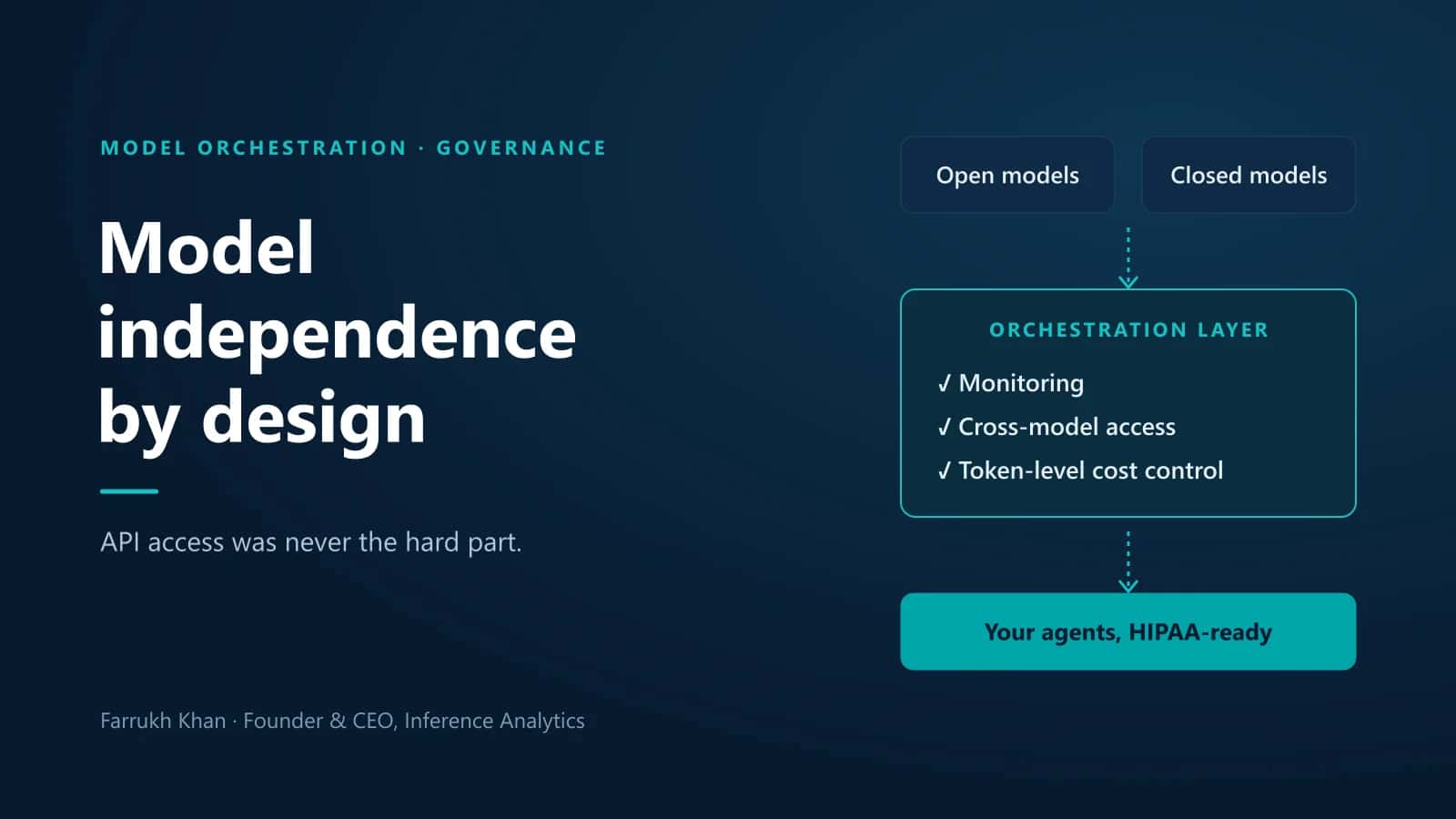
The trust boundary lives in orchestration, not infrastructure: one layer that sits between your team and every model, open or closed. That layer holds three things in place:
- Monitoring of every model call and agent
- Cross-model access, so teams use the right model for each task
- Token-level cost control, so spend stays visible by team and use case
It is HIPAA-ready today, with SOC compliance underway.
Switching models becomes a routing decision
When the platform is model-agnostic, changing models is a routing decision, not a re-architecture. Teams adapt as prices and capabilities shift, and build agents instead of infrastructure.
That's the layer Inference Analytics AI has been building with Dev Studio on InferAgents.ai: a model-agnostic orchestration platform built on model independence. Deploy agentic AI in secure, HIPAA-regulated environments today, switch models freely as prices and capabilities shift, with SOC 2-track infrastructure coming next.