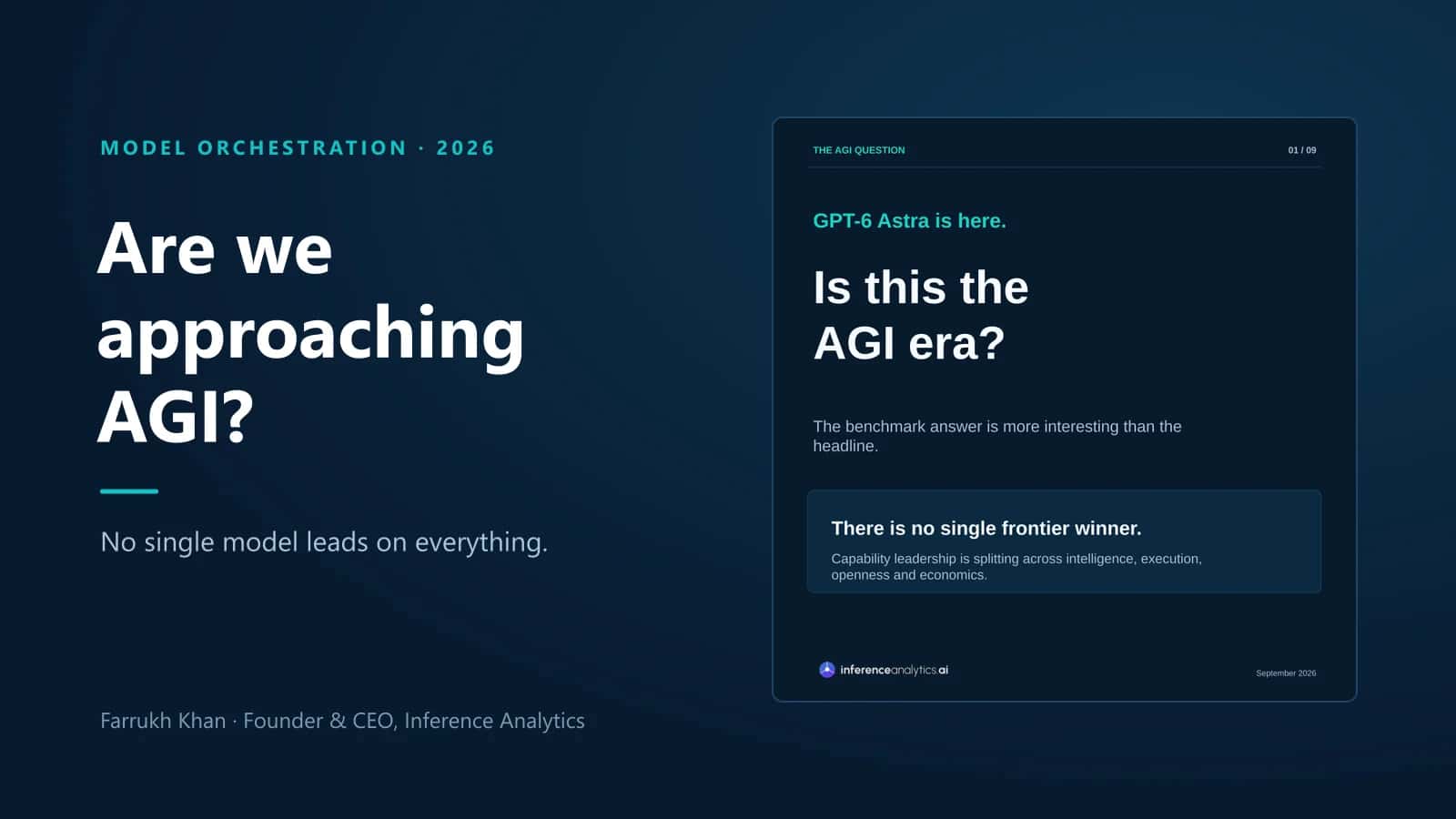
With the arrival of GPT-6 Astra, some industry leaders are beginning to describe this as the start of an “AGI era.” The claim is provocative, but it is not without substance.
AGI should represent more than exceptional performance on a single benchmark. It implies broad reasoning across domains, the ability to adapt to unfamiliar problems, sustained autonomy, effective tool use, and the judgment to complete complex work reliably. No single model possesses all these attributes equally today.
The frontier has fragmented
Capability leadership is splitting across intelligence, execution, openness and economics. Four models now lead for four different reasons:
- GPT-6 Astra: execution. Computer use, terminal work and science.
- Claude Fable 5.1: broad intelligence. Reasoning, coding judgment and research.
- DeepSeek-V4: open economics. Open weights, a 1M-token context and local control.
- Gemini 3.8 Flash: speed at scale. Multimodal, a 1M-token context and a low price.
What the benchmarks say
On the Artificial Analysis Intelligence Index (v4.1.1), Claude Fable 5.1 leads at 65.7, ahead of GPT-6 Astra at 61.2 and Gemini 3.8 Flash at 58.7. A five-point gap is meaningful, but an aggregate hides where each model wins.
In head-to-head results reported by OpenAI on Terminal-Bench 4.0, Terminal-Bench Science, BenchCAD and AutomationBench, GPT-6 Astra wins where work gets executed. Benchmark settings matter, and vendor-reported comparisons are not a substitute for your own evals.
Astra's advantage is not merely answering but operating: computer use across browser, desktop and professional software, long-horizon terminal work, 97.6% on FrontierMath Tier 4 and 64.6% on Terminal-Bench Science. The trade-off is price: $10 per million input tokens and $50 per million output tokens at standard API rates.
Claude Fable 5.1 is the intelligence counterweight. It leads the broad aggregate and stands out in complex research, readable reasoning across long multi-step tasks, and coding with verification loops, with 65.0% on Humanity's Last Exam with tools. Its reported list pricing is comparable to Astra's, not clearly cheaper.
Open and efficient models change the decision
Frontier capability is only one part of enterprise value. DeepSeek-V4 offers open-weight control and a 1M-token context by default, a strong fit when deployment control matters. Gemini 3.8 Flash offers a 1,048,576-token context, native multimodality and a cost-focused profile, a strong fit for high-volume workflows. Llama 4 remains influential, but is no longer the cleanest proxy for the 2026 frontier.
Choose the workload, not the winner
The best model is the one that completes your task reliably, safely and economically.
| Workload | Best fit today |
|---|---|
| Desktop and terminal agents | GPT-6 Astra |
| Broad reasoning and research | Claude Fable 5.1 |
| Local or open-weight deployment | DeepSeek-V4 |
| High-volume multimodal workflows | Gemini 3.8 Flash |
To compare fairly, give each model the same task, the same tools, the same data and the same retry budget, and measure the total cost per completed task.
The bottom line
What we may be approaching is not AGI embodied in one model, but an increasingly general intelligence emerging from multiple models, tools, agents and data systems working together.
At Inference Analytics AI we believe this distinction matters. For enterprises, especially in healthcare the real breakthrough will come when these capabilities can be orchestrated securely, the models used in coordinated and combined workflows while being governed responsibly and applied reliably to real-world workflows.
Real advantage comes from the system around the model: evaluation, orchestration, governance and workflow fit. The AGI era may not begin with a single declaration. It may arrive as systems become capable of reasoning and acting across the boundaries that once constrained them.